
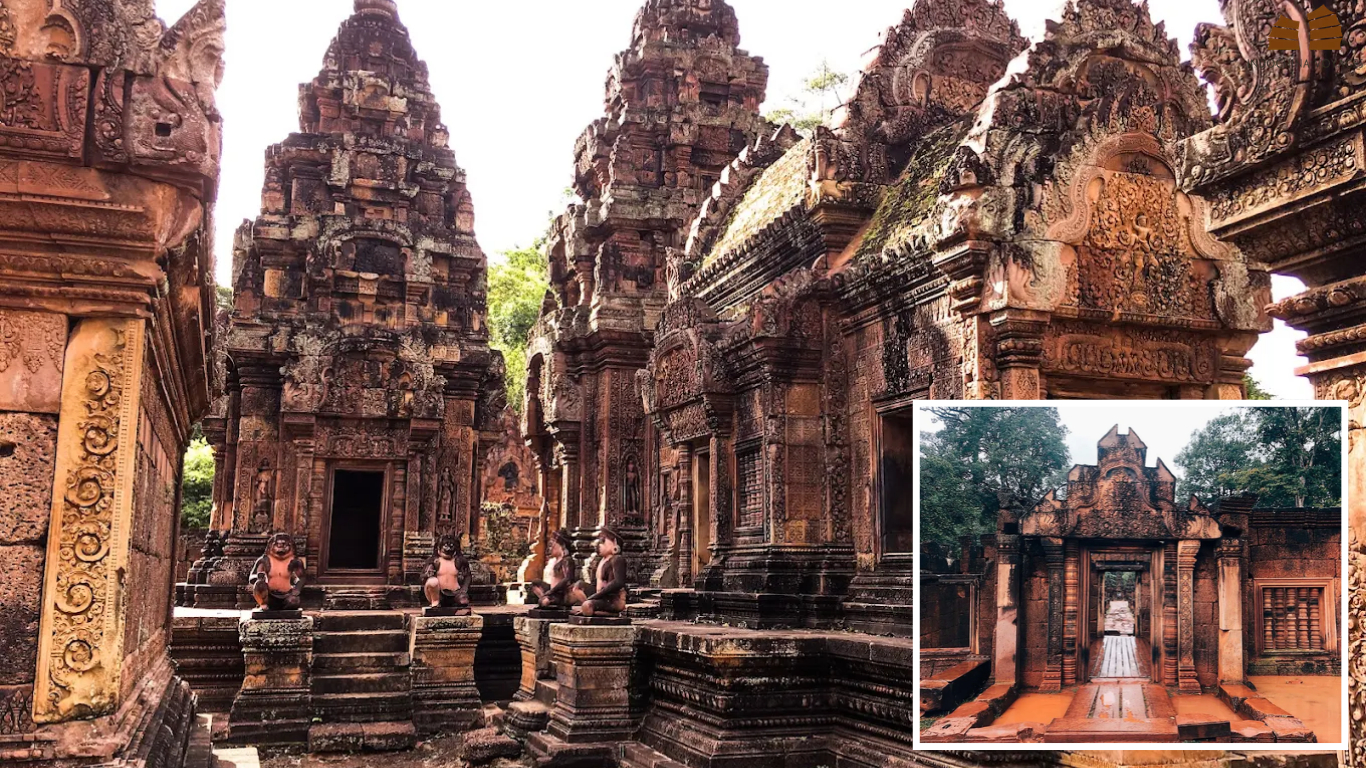
Banteay Srei Temple earns its reputation through restraint of scale and abundance of detail. Where Angkor Wat overwhelms with mass, this small sanctuary of pink sandstone draws the eye inward, to doorways, pediments and wall surfaces carved with extraordinary density. Set in the Angkor region of northern Siem Reap Province, it dates to the 10th century and was built as a Hindu temple dedicated to Shiva, roughly a century and a half before Angkor Wat. The sections below trace who commissioned it, how its builders worked the stone, what the carvings depict, and where the temple sits within the longer story of Khmer art.
Key Facts About Banteay Srei Temple, Explained
Banteay Srei is a 10th-century Hindu temple in the Angkor region of Cambodia, consecrated in 967 and dedicated to Shiva. Commissioned by court counsellors rather than a king, it is celebrated for its compact proportions and for some of the finest relief carving in Khmer architecture.
| Fact | Detail | Why it matters |
|---|---|---|
| Date | Consecrated on 22 April 967 | Pre-dates both Angkor Wat and Angkor Thom |
| Reign | Rajendravarman II, with the founder also serving under Jayavarman V | Places the temple at a hinge between two reigns |
| Founders | Yajnavaraha, with his brother Vishnukumara | A rare major Angkor temple not built by a monarch |
| Dedication | Shiva | The central sanctuary honours Shiva |
| Original name | Tribhuvanamahesvara | Differs from the modern name |
| Materials | Pink to red sandstone, with laterite and brick in walls and some structures | The stone made fine carving possible |
| Location | About 20–25 km northeast of the main Angkor group, and roughly 30–37 km by road from Siem Reap | Explains why it is usually a separate excursion |
| Rediscovery | 1914 | Early observers dated it far too late because of its refinement |
For current transport, hours and pass details, see our Banteay Srei visitor guide.
Who Built Banteay Srei, and Why It Was Not a King
Before the history begins, take a moment to see Banteay Srei move.
A 10th-century setting
Banteay Srei belongs to the reign of Rajendravarman II, a period when the Khmer court was consolidating power after a move back to the Angkor region. The king’s own state temple, Pre Rup, was dedicated in the early 960s and shows what a royal commission looked like: a large temple-mountain on a monumental plan. Banteay Srei followed within a few years and took a very different path.
The patrons
The temple was founded by Yajnavaraha, a Brahmin scholar and counsellor at court, together with his brother Vishnukumara. According to the foundation inscription, Yajnavaraha was known as a learned man who aided people suffering from illness, injustice or poverty. Official Cambodian accounts describe the founder as a dignitary who served under Rajendravarman and then under Jayavarman V, which explains why older texts link the temple to the later king. A private foundation of this scale, built in fine stone and decorated by leading artisans, points to considerable wealth and standing at court.
Name and dedication
The temple was originally called Tribhuvanamahesvara, usually translated as “great lord of the threefold world”, a reference to the Shiva linga at its heart. The name Isvarapura also appears in discussions of the site, but sources differ on whether it designates the surrounding settlement or the temple itself, so it is best treated as an area of scholarly variation rather than a settled point.
What is documented, and what is interpretation
The date, the founders and the dedication come from inscriptions. Readings of Yajnavaraha’s political weight, or of why he chose to build on this scale, are interpretations and should be read as such.
💡Traveller tip: Ask your guide to point out the inscribed door jambs at the inner enclosure tower. These carry the written record behind the history above, and they are easy to walk past without context.
Pink Sandstone and Compact Design: How the Temple Was Built
Stone and colour
The builders used a hard, fine-grained sandstone, reported to come from the Phnom Kulen region, in shades from pink to reddish brown. Although hard, it can be carved much as wood would be, which allowed sculptors to cut deep, crisp detail. Its colour shifts with the light, glowing in the morning and deepening toward evening. Later Angkor temples generally used sandstone of other shades, which is one reason Banteay Srei looks so distinct.
Layout of the complex
Like most Khmer temples, Banteay Srei faces east. A gateway opens onto a causeway that leads through three concentric enclosures, with a moat and a central cruciform sanctuary honouring Shiva. Two libraries stand in the inner enclosure. The outer gateway is laterite trimmed with sandstone, a useful contrast that shows how the builders reserved the finest stone for the most important surfaces.
Lintels and pediments
A lintel is the horizontal beam above a doorway, and a pediment is the triangular or gabled panel above it. At Banteay Srei the pediments are large relative to the openings beneath them and sweep upward in a gabled form. For the first time in Khmer architecture, whole mythological scenes appear on these surfaces rather than isolated motifs. That change turned doorways into narrative panels.
Scale versus ornament
The whole complex is small, with the distance from the eastern to the western gateway only about 200 metres. Its impact therefore comes from decoration rather than mass: relief depth, symmetry, and figures that grow out of the architecture instead of sitting on it. This is a different artistic ambition from Angkor Wat, not a better or worse one.
Traveller tip: Arrive early, when the stone takes on its warmest colour and the grounds are quietest. Late afternoon is the second-best window.
Reading the Carvings: Ramayana Scenes, Devatas and Guardians

Narrative pediments
The clearest stories appear on the libraries. On the east pediment of the southern library, the demon king Ravana shakes Mount Kailasa beneath Shiva and Parvati. On the west pediment, Kama, the god of love, aims an arrow at Shiva and is reduced to ashes by the god’s gaze. The east pediment of the northern library shows Indra bringing rain to quench a forest fire, a scene from the Mahabharata tradition. Other pediments depict episodes from the Ramayana, including the duel of Vali and Sugriva and the abduction of Sita, and Vishnu-related themes such as the Killing of Kamsa. Sources place some of these scenes on different gateways and buildings, so a guide on site is the best way to confirm where each one sits.
Devatas, guardians and celestial beings
The female figures set in niches on the sanctuary walls are devatas, a term for female divine beings, usually shown standing and holding lotus flowers. Guardian figures, known as dvarapalas, flank doorways and the corners of the central tower. Celestial beings of other kinds appear in the upper registers. Using “devata” for every woman in the reliefs flattens this distinction, which is worth keeping in mind when reading captions or listening to guides.
Story or ornament?
Not every surface tells a story. Foliage, scrolling vines and geometric patterns fill much of the central sanctuary, and the walls there leave almost no stone uncarved. Narrative panels sit within this decorative field. Learning to separate them makes the temple legible instead of merely busy.
What survives in place: replicas and museum originals
Many of the sculptures now standing at Banteay Srei are replicas, because the originals were stolen or moved to museums for safekeeping. Two famous pediments are held at the National Museum of Cambodia in Phnom Penh and at the Guimet Museum in Paris. The guardian figures seen today are also copies of originals kept in the national collection.
Traveller tip: Stand back from each pediment first to read the whole scene, then step closer for detail. Walking straight up with a camera is the surest way to miss the story.
What Does Banteay Srei Mean? The Truth Behind “Citadel of Women”
“Banteay” means citadel and “Srei” relates to women, giving the common translation “Citadel of Women”. A second reading, “Citadel of Beauty”, is also widely used. Both are modern names. The temple’s original name, Tribhuvanamahesvara, refers to Shiva.
The modern name is generally linked to the delicacy of the carving and the small scale of the buildings. A popular explanation holds that the reliefs were so fine that only women could have carved them. That is a traditional interpretation, not historical evidence, and the name does not establish who the artisans were.
From Forest Ruin to Restored Jewel: Rediscovery, Theft and Conservation
Vegetation concealed the temple until its rediscovery in 1914. Its refined carving led early observers to guess at a much later date, and inscriptions later established the 10th-century foundation. In 1923 the French writer André Malraux was arrested after attempting to remove several carved pieces, an incident that drew international attention to the temple and strengthened protection.
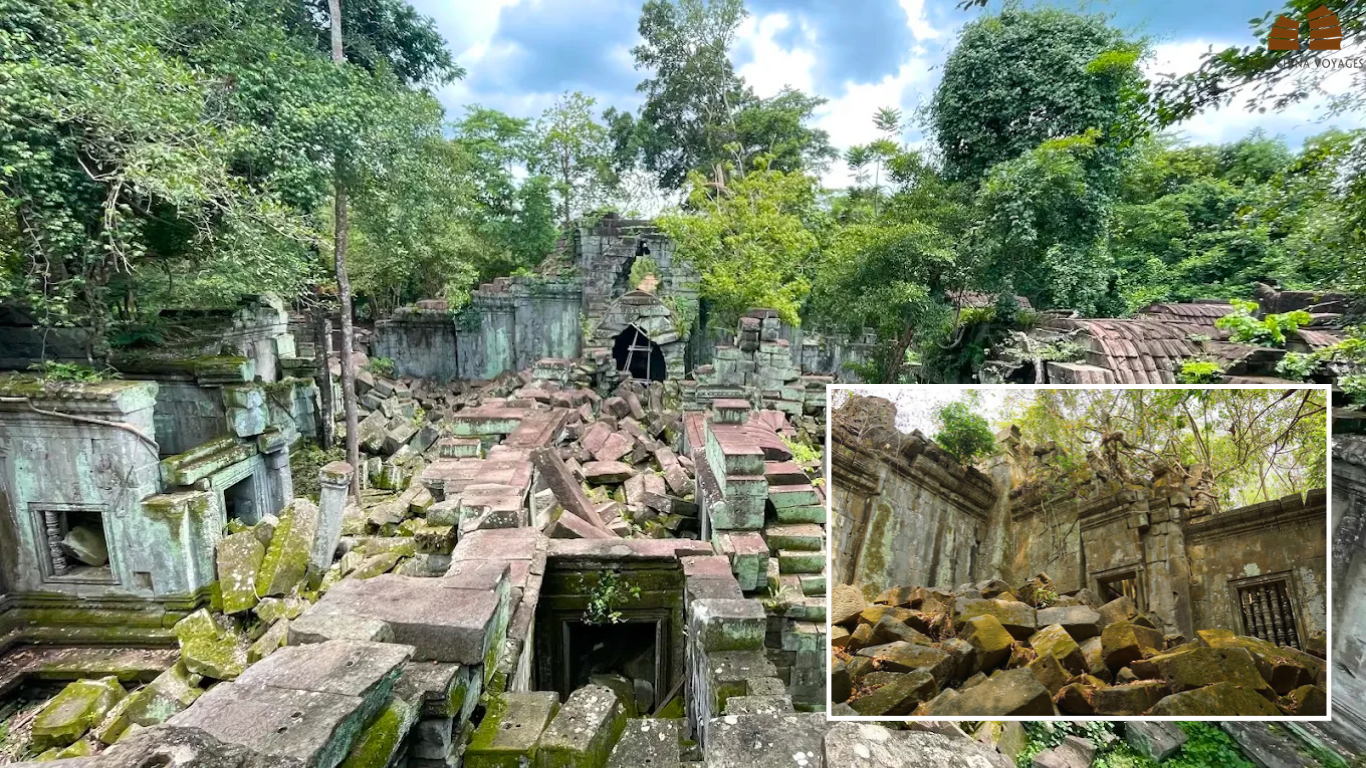
Restoration followed in the 1930s, when Banteay Srei became the site of the first important use of anastylosis at Angkor, a method that dismantles a structure and reassembles it with its original stones. A Swiss-supported conservation project in the early 2000s addressed drainage and structural stability. For a contrast, see Beng Mealea, a sandstone temple left largely unrestored.
Banteay Srei in Khmer Art History: Where It Sits Among Angkor’s Temples
Banteay Srei is a defining example of 10th-century Khmer architecture, and its style is named after it. Its sculptural programme reflects how Hindu traditions shaped Angkorian art, translating epic and Puranic stories into stone. It differs from later monuments such as the Bayon in period, style and sculptural expression: the Bayon belongs to the Buddhist-era reign of Jayavarman VII, with monumental faces and large-scale reliefs, while Banteay Srei concentrates its energy in fine ornament.
It also belongs to a wider landscape. The Angkor region contains monuments from several centuries, and seeing Banteay Srei alongside the larger temples shows how Khmer art changed. Ta Prohm, a Buddhist monastery complex from the late 12th century, offers a useful comparison.
Is Banteay Srei Worth Visiting? An Honest Answer
Banteay Srei is particularly rewarding for visitors interested in Khmer sculpture, religious art, architectural detail and the history of Angkor. Its small scale makes a useful contrast to the great monuments, and it rewards slow looking more than long walking.
There is a trade-off. The temple lies farther from the main Angkor group, so travel time needs planning. Travellers with only a short stay in Siem Reap may prefer to prioritise the central temples first, using our guide to the best time to visit Angkor Wat to shape the rest of the schedule. Those who want to understand the craftsmanship and context behind the monuments will probably enjoy it most. For more ideas around the city, see things to do in Siem Reap beyond Angkor Wat.
Combining Banteay Srei With Nearby Sites
Banteay Srei pairs naturally with sites along the same road. Banteay Samre, a 12th-century temple from the Angkor Wat period, offers a useful stylistic contrast. Kbal Spean, the “River of a Thousand Lingas”, involves a forest walk of roughly 45 minutes uphill, which is a moderate effort and adds real time to the day. The Cambodia Landmine Museum is another common stop. Our Siem Reap In Depth 5 Days itinerary shows one way to build these excursions into a longer stay.
A guide adds real value here, identifying the religious narratives and architectural details that visitors otherwise overlook. Temples also require covered shoulders and knees, so see what to wear in Cambodia before you pack.
Traveller tip: Visit Banteay Srei at opening time, then continue to Kbal Spean before the midday heat. Reversing the order means the hike falls in the hottest part of the day.
For current transport, opening hours, tickets and timing advice, use our Banteay Srei visitor guide.
Frequently Asked Questions About Banteay Srei
When was Banteay Srei built?
Banteay Srei was consecrated on 22 April 967, in the 10th century. It was expanded and rebuilt in the 11th and 12th centuries.
Who built Banteay Srei?
It was commissioned by Yajnavaraha and his brother Vishnukumara, who were court counsellors and Brahmin scholars rather than kings. It is one of the few major Angkor temples not built by a monarch.
Why is Banteay Srei called the Citadel of Women?
The name is commonly translated as “Citadel of Women” or “Citadel of Beauty”. It is generally linked to the delicacy of the carving and the small scale of the buildings, but it does not prove that women carved the temple.
What is Banteay Srei famous for?
The temple is renowned for its pink sandstone and for finely carved pediments, lintels and wall reliefs that depict Hindu stories, deities and decorative motifs.
How is Banteay Srei different from Angkor Wat?
The two differ in date, scale, design and religious history. Banteay Srei is a compact 10th-century temple dedicated to Shiva, built by court counsellors, while Angkor Wat is a vast 12th-century royal monument.
How long should you allow for Banteay Srei?
Allow roughly 1 to 1.5 hours on site to look at the carvings without rushing, plus travel time from Siem Reap. Our visitor guide covers practical timing in more detail.