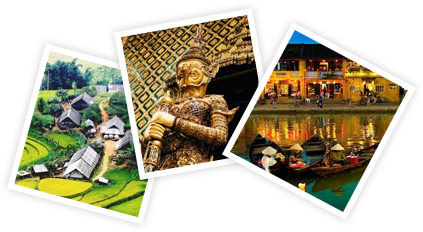

Planning a Vietnam and Cambodia itinerary is mostly a question of what to leave out. Vietnam alone stretches more than 1,600 km from north to south, so the two countries together are bigger than they look on a map.
Vietnam brings cities, food, limestone landscapes and river life. Cambodia adds the temples of Angkor, a harder history and a slower pace. Whether you plan your own route or start from one of our Vietnam tours, the trick is choosing the right number of stops so that you’re not spending the trip in airports.
How long to spend in Vietnam and Cambodia?
| Trip length | Vietnam | Cambodia | Best for |
|---|---|---|---|
| 10–12 days | 6–8 days | 3–4 days | Highlights, limited time |
| 14–17 days | 9–12 days | 4–6 days | First-time Vietnam + Cambodia |
| 18–21 days | 12–14 days | 6–8 days | Slower, deeper exploration |
There’s no single correct split. Travelers drawn to temples can give Cambodia more time. First-timers usually need more days in Vietnam, because its main regions are far apart.
>>>>Not sure which country deserves more of your time? Read: Cambodia or Vietnam: which to visit?
10 to 12 Days: Focus on the Highlights
Pick one or two regions of Vietnam, such as Hanoi and Ha Long Bay plus either Hoi An or Ho Chi Minh City. Then fly to Siem Reap for Angkor. In contrast, fitting Hanoi, Ha Long, Hue, Hoi An, Ho Chi Minh City, the Mekong Delta, Phnom Penh and Siem Reap into 10 days means a transfer almost every day.
14 to 17 Days: The Classic Route
This is the route most first-time visitors choose: Hanoi → Ha Long Bay → Hoi An → Ho Chi Minh City → Mekong Delta → Phnom Penh → Siem Reap. Because it runs north to south, you never backtrack. At 14 days, however, you’ll need to trim one stop (usually Phnom Penh). At 17 days, on the other hand, everything fits comfortably.
18 to 21 Days: Travel More Slowly
Extra days are best spent on what makes the trip richer, not on more transfers. For example, you can add Ninh Binh, Hue, a third night in Hoi An, a Mekong Delta overnight, two nights in Phnom Penh, three days around Angkor, or a beach stop.
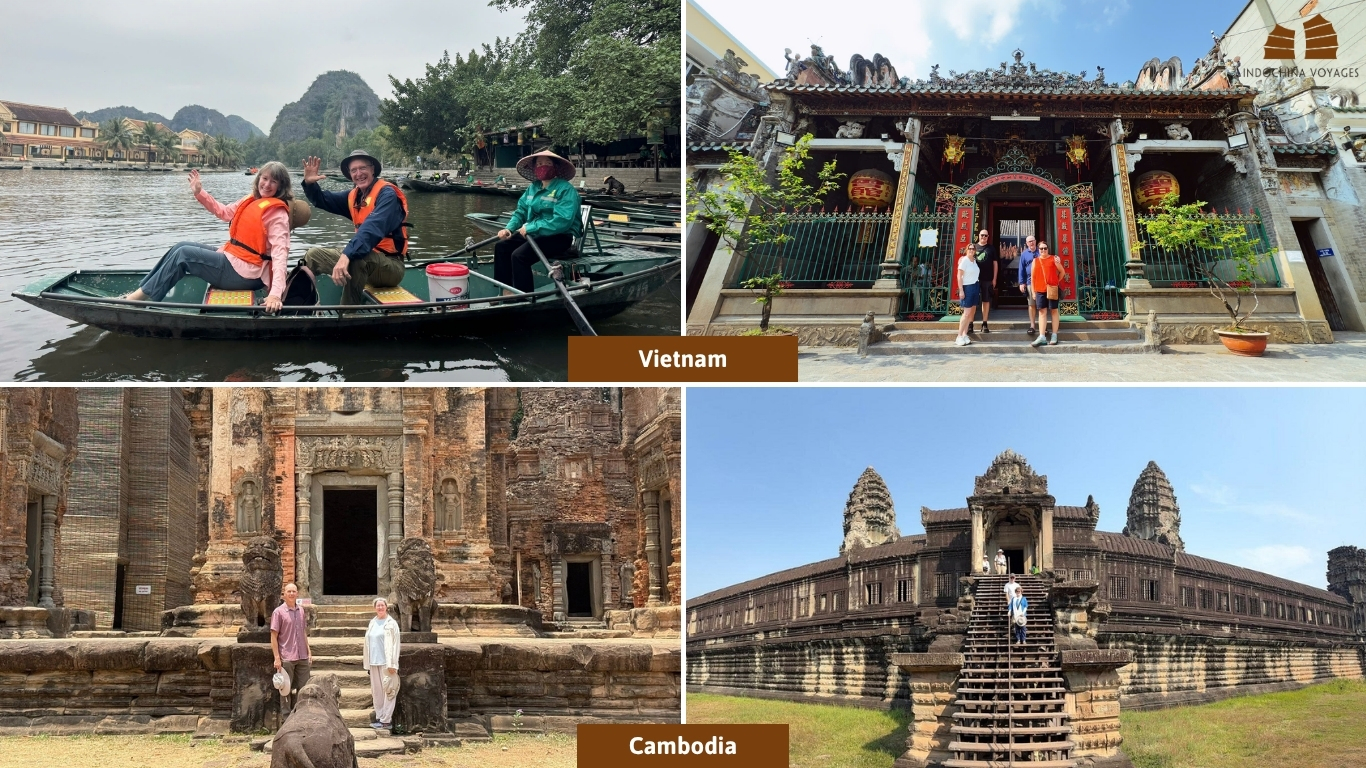
The Classic 14-Day Vietnam Cambodia Itinerary
This route covers 9 days in Vietnam and 5 in Cambodia, and gives Siem Reap enough time that Angkor doesn’t feel rushed.
Days 1 – 4: Hanoi and Ha Long Bay
- Day 1: Arrive in Hanoi. Then walk the Old Quarter and Hoan Kiem Lake.
- Day 2: Visit Hanoi’s main sights, such as the Ho Chi Minh Mausoleum complex and the Temple of Literature. Afterward, join a food tour.
- Day 3: Transfer to Ha Long Bay (about 2.5–3.5 hours by road). Then board an overnight cruise.
- Day 4: Enjoy the morning on the bay, then return to Hanoi for an afternoon flight to Da Nang. Next, transfer to Hoi An. An afternoon flight keeps the day from feeling rushed.

Days 5 – 7: Hoi An
- Day 5: Hoi An Ancient Town, a cooking class or lantern workshop.
- Day 6: My Son Sanctuary in the morning, An Bang Beach or a countryside cycle in the afternoon.
- Day 7: Fly to Ho Chi Minh City.
Days 8 – 9: Ho Chi Minh City and the Mekong Delta
- Day 8: Cu Chi Tunnels, the War Remnants Museum and the city center.
- Day 9: Mekong Delta day trip by boat, through orchards and canals, returning to the city.
Days 10 – 14: Siem Reap and Angkor
- Day 10: Fly Ho Chi Minh City to Siem Reap (about 1 hour 15 minutes). Free evening.
- Day 11: Angkor Wat at sunrise, then Angkor Thom and the Bayon.
- Day 12: Ta Prohm and Banteay Srei.
- Day 13: Tonle Sap floating villages or a countryside visit, with an Apsara dance performance in the evening.
- Day 14: Departure.
Note: If you want Phnom Penh in 14 days? Trim the Mekong Delta day trip and take the 1-hour flight from Ho Chi Minh City to Phnom Penh on Day 9, then continue to Siem Reap on Day 11. Siem Reap shrinks to two full days, so we don’t recommend it for a first Angkor visit.
Got spare time in one of these cities? These guides go beyond the main sights:
- Hanoi off the beaten path
- Unique things to do in Hoi An
- Explore life in Saigon alleys: Saigon travel guide
- Siem Reap tours: 5 activities besides Angkor Wat
A More Comfortable 17-Day Vietnam Cambodia Itinerary
This version adds Hue, Ninh Binh and Phnom Penh without piling up too many one-night stops. It’s a lighter, updated take on our classic 17-day route.
Phase 1: Vietnam (Days 1–11)
- Days 1–2: Hanoi. Begin with the Old Quarter and the Ho Chi Minh complex, then explore local markets and street food.
- Day 3: Ninh Binh. Take a day trip to Trang An or Tam Coc by boat, then visit Hoa Lu. Overall, it gives you a taste of northern Vietnam’s countryside without the long trek to Sapa.

- Days 4–5: Ha Long Bay. Enjoy an overnight cruise with kayaking, caves and fishing villages. On Day 5, return to Hanoi and then fly to Hue.
- Day 6: Hue. Visit the Imperial Citadel and Thien Mu Pagoda. Afterward, take a Perfume River cruise.
- Days 7–8: Hoi An. First, drive from Hue over the Hai Van Pass. Then enjoy Old Town, My Son and An Bang Beach.
- Day 9: Fly to Ho Chi Minh City.
- Day 10: Explore Ho Chi Minh City highlights, then visit the Cu Chi Tunnels.
- Day 11: Visit the Mekong Delta, either by day trip or overnight toward Chau Doc.
Phase 2: Vietnam to Cambodia (Day 12)
- Option A, flight: Fly Ho Chi Minh City to Phnom Penh, about an hour in the air.
- Option B, Mekong speedboat: Stay overnight in Chau Doc on Day 11. Then take a morning speedboat up the Mekong to Phnom Penh. It’s slower, but far more memorable.
Phase 3: Cambodia (Days 12–17)
- Days 12–13: Phnom Penh. Visit the Royal Palace and Silver Pagoda. Then see the Tuol Sleng Genocide Museum and the Killing Fields. Because these sites are sobering, leave room in the day.
- Day 14: Transfer to Siem Reap by road or short flight.
- Days 15–16: Start with Angkor Wat and Angkor Thom. Then continue to the Bayon, Ta Prohm and Banteay Srei.
- Day 17: Visit Tonle Sap, then depart.
Hoi An gets only two nights here. If you’d rather have a third, drop Ninh Binh.

>>>> Read this one to find more to do in Phnom Penh: Unusual things to do in Phnom Penh
A 21-Day Vietnam Cambodia Itinerary for Slow Travel
Three weeks isn’t the 17-day route with filler days. Instead, it’s the same route with room to breathe. Here is what the extra time buys in each region:
| Region | Days | What the extra time adds |
|---|---|---|
| Northern Vietnam | 1–5 | Hanoi, Ninh Binh with an overnight, Ha Long Bay cruise |
| Central Vietnam | 6–10 | Hue, Hoi An, My Son, plus beach and countryside time |
| Southern Vietnam | 11–15 | Ho Chi Minh City, Cu Chi, an overnight in the Mekong Delta, a slow village or homestay stop |
| Cambodia | 16–21 | Phnom Penh, optional Battambang, 3 days around Angkor, Tonle Sap and countryside |
Battambang is a worthwhile add here. It’s a relaxed provincial town with colonial streets and a bamboo train, but it’s too far afield for shorter trips.
Looking for Cambodia add-ons like Battambang? Browse our Cambodia tours. Three weeks can be tailored in many ways. Read more about longer routes.
Short on Time? Southern Vietnam and Cambodia in 13 Days
If you want to skip northern and central Vietnam, this south-focused route gives Cambodia more time.
- Days 1–3: Start in Ho Chi Minh City. Then visit the Cu Chi Tunnels and the Cao Dai Temple.
- Days 4–5: Next, enjoy a Mekong Delta cruise and see rural life.
- Day 6: Cross the border to Phnom Penh. Then see the Royal Palace, Silver Pagoda and Tuol Sleng.
- Days 7–8: Continue to Battambang, with Phnom Sampeau and Phnom Banon.
- Days 9–13: Finally, spend five days in Siem Reap and Angkor, including Beng Mealea and Tonle Sap.
>>>> Ready-made option: Discovery Southern Vietnam & Cambodia 13 days
Which Stops Should You Keep or Cut?
| Destination | Stay | Why include it | Consider skipping when |
|---|---|---|---|
| Hanoi | 2–3 nights | Culture, food, history | Very short trip |
| Ninh Binh | 1–2 nights | Countryside, boat rides | Days are limited |
| Ha Long Bay | 1–2 nights | Limestone scenery | You prefer land travel |
| Hue | 1–2 nights | Imperial history | You’d rather have more Hoi An |
| Hoi An | 2–3 nights | Heritage, food, beach | Short itinerary |
| Ho Chi Minh City | 2–3 nights | City life, history | You want more rural time |
| Mekong Delta | 1–2 nights | River and village life | Very short trip |
| Phnom Penh | 1–2 nights | Cambodian history | You want maximum Angkor time |
| Siem Reap | 3–4 nights | Angkor temples | Almost never on a first trip |
Four ways to combine them:
- Classic first trip: Hanoi → Ha Long Bay → Hoi An → Ho Chi Minh City → Phnom Penh → Siem Reap
- Nature and slower travel: Hanoi → Ninh Binh → Ha Long Bay → Hoi An → Mekong Delta → Siem Reap
- History and culture: Hanoi → Hue → Hoi An → Ho Chi Minh City → Phnom Penh → Siem Reap
- 10–12 days: Cut Vietnamese stops, not Cambodian ones. Pick one northern, one central or southern stop, then Siem Reap.
Each of these combinations can be arranged within our Indochina tours.
How Much Does a Vietnam and Cambodia Trip Cost?
The price of private Vietnam tour packages that continue into Cambodia depends on four things: how many people are traveling, the hotel level, the season, and how many flights and cruises are included. Group size has the biggest effect, because transport and guide costs are shared.
For example, our 17-day Splendors of Vietnam & Cambodia tour, at the Superior hotel level, is priced per person like this for 2026:
| Group size | Price per person (Superior) |
|---|---|
| 2 people | US$2,512 |
| 3–4 people | US$2,238 |
| 5–6 people | US$1,983 |
| 7–8 people | US$1,882 |
Prices assume two people sharing a room, so solo travelers pay a single supplement (about US$791 on this tour). Higher hotel categories cost more, and customized itineraries, such as the 14-day and 21-day routes above, are priced individually. To get a quote, contact our team.
What’s usually not included (check your tour’s inclusions list): international flights, visa fees, tips for guides and drivers, travel insurance, and personal spending such as drinks and shopping.
If you’re pricing things separately, here are some fixed costs:
- Angkor Pass: US$37 for 1 day, US$62 for 3 days, US$72 for 7 days.
- Visas: about US$30 for Cambodia, and around US$25 for a single-entry Vietnam e-visa (see the visa section below).
- Mekong speedboat, Chau Doc to Phnom Penh: roughly US$20–35 for the ticket alone, more when bundled with transfers.
- Flight, Ho Chi Minh City to Phnom Penh or Siem Reap: roughly US$50–200 one way, depending on date and how early you book.
Ways to bring the cost down:
- Travel with 3–4 people rather than 2.
- Choose March–April or October, which many guides call good-value shoulder months.
- Fly fewer internal legs by dropping a stop.
How to Travel From Vietnam to Cambodia
| Option | Time | Best for | Keep in mind |
|---|---|---|---|
| Flight | About 1–1.25 hours | Speed, comfort, short trips | Ho Chi Minh City → Phnom Penh or Siem Reap run several times daily. Da Nang → Siem Reap is more limited, so check the schedule. |
| Overland (bus or private car) | 6–7 hours HCMC → Phnom Penh | Travelers who enjoy road journeys | The border is Moc Bai–Bavet, about 2 hours from Ho Chi Minh City. Expect immigration queues. |
| Mekong speedboat | 5–6 hours road to Chau Doc, then 4.5–5 hours by boat | Scenery and the experience | Boats typically leave Chau Doc in the early morning. Not for those short on time. |
How Each Option Works
Flying. There are non-stop flights from Ho Chi Minh City to both Phnom Penh and Siem Reap, and Da Nang to Siem Reap takes about 2 hours. Two airports have changed recently. Phnom Penh’s flights now use the new Techo International Airport, about 25 km south of the city center. Siem Reap’s flights land at Siem Reap–Angkor International, which is farther from town than the old airport. Allow extra transfer time on both.
Overland. The Ho Chi Minh City → Phnom Penh route is the most common land crossing. It suits travelers who want to see the countryside, but it takes most of a day and isn’t ideal for a tight itinerary.
Mekong speedboat. There’s no boat from Ho Chi Minh City itself, so you drive to Chau Doc first and typically stay overnight. The boat then follows the river to Phnom Penh. Choose it for the journey, not to save time.

>>>> Read more about border crossings and reverse routes:
- How to get from Vietnam to Cambodia
- How to travel from Phnom Penh to Ho Chi Minh City: the best ways to travel
- Siem Reap to Saigon
Need the crossing arranged for you? Ask about custom Indochina packages.
Visas and Entry Requirements for Vietnam and Cambodia
You’ll need to arrange entry for each country separately. Rules change often, so check the official site for your passport before you book.
| Vietnam | Cambodia | |
|---|---|---|
| Who needs a visa | Most travelers. Citizens of some countries, including many European ones, the UK, Japan and South Korea, can enter visa-free for 45 days. | Most travelers (some ASEAN passport holders are exempt). |
| Main option | E-visa, valid up to 90 days, single or multiple entry | Tourist e-visa or visa on arrival, 30 days, single entry |
| Cost | About US$25 (single), US$50 (multiple) | About US$30 (some sources add a small processing fee) |
| Processing | Around 3–5 working days | Around 3 business days (visa on arrival is issued at the counter) |
| Apply | evisa.gov.vn | evisa.gov.kh |
| Also required | Passport valid for at least 6 months | Passport valid 6+ months, plus the free e-Arrival Card |
Cambodia’s e-Arrival Card is free and mandatory for air arrivals. Complete it online within 7 days before arrival. It isn’t a visa, and you need both.
Watch for lookalike websites. Several unofficial sites charge far more than the real fee. Apply only through the official government portals listed above.
The Mekong river crossing. Advice conflicts on whether Cambodian e-visas work at the river border near Chau Doc, and a visa on arrival is typically available there. If you cross by speedboat, ask your tour operator what to carry.
If your route returns to Vietnam (for example, flying out of Ho Chi Minh City after Cambodia), a single-entry Vietnam visa won’t be enough. You’ll need a multiple-entry e-visa, or check whether your passport’s exemption allows re-entry.
A simple timeline:
- 4–6 weeks before: Apply for your Vietnam e-visa.
- 1–2 weeks before: Apply for your Cambodia e-visa.
- Within 7 days of arrival: Complete the Cambodia e-Arrival Card.
- Before you leave home: Print copies of everything and save them on your phone. Border posts can lose connectivity.
Have questions about entry requirements for your route? Talk to our team
Best Time for a Vietnam and Cambodia Itinerary
| Period | Vietnam | Cambodia | Planning note |
|---|---|---|---|
| Nov–Feb | Dry and comfortable in the south, cool in the north | Dry season | Most popular window |
| Mar–Apr | Hot, mostly dry | Very hot, often 35°C+ | Plan sightseeing early and late |
| May–Oct | North and south get rain; central coast is best in summer | Wet season | Green landscapes and fewer crowds |
No month gives identical weather in both countries. Central Vietnam in particular is wettest from around September to December. Route choice matters as much as the month.
>>>> For month-by-month detail, read: When is the best time of year to visit Vietnam and Cambodia? Pick your month first, then see which of our Indochina tours match.
Practical Tips for Planning Vietnam and Cambodia
Planning the route
- Book an open-jaw international flight. Fly into Hanoi and out of Siem Reap (or the reverse) so you never backtrack.
- A travel day isn’t a sightseeing day. A day with a flight, airport transfer and hotel check-in realistically gives you only a few hours.
- Limit hotel changes. Prefer two- or three-night stays where you can.
- Give Angkor at least three days. A 3-day pass lets you split temples between mornings and evenings.
- Fly between regions. Domestic flights save many hours between northern, central and southern Vietnam.
- Allow extra time at airports. Phnom Penh’s new Techo airport and Siem Reap’s new airport are both farther from the city than the old ones.
- Consider private transfers for the border crossing. A driver and guide on both sides can handle customs and visas and avoid long waits.
Money
- Vietnam uses the dong (VND). Carry small notes for tips, and use local currency rather than dollars when tipping.
- Cambodia uses US dollars widely alongside the riel, so bring crisp, undamaged US notes. Torn ones are routinely refused, including for a visa on arrival.
Tipping
Tipping is not mandatory in either country, but it’s increasingly customary on guided tours. Amounts vary widely between sources, so treat these as rough guidelines:
| Who | Typical amount |
|---|---|
| Private guide (per day) | About US$5–10 |
| Private driver (per day) | About US$3–5 |
| Group tour guide (per person, per day) | About US$4–8 in Vietnam, somewhat less in Cambodia |
| Restaurants | Round up, or about 5–10% for very good service |
| Taxis | Round up |
Temples and culture
- Cover your shoulders and knees at Angkor, the Royal Palace and pagodas.
- Treat sites like Tuol Sleng and the Killing Fields with respect, and allow time to process the visit.
>>>> A little preparation goes a long way on a two-country trip. These two guides cover what to pack and what to eat:
Want the border crossing and transfers handled for you? Ask Indochina Voyages about private transfers.
Vietnam and Cambodia Itinerary FAQs
Extend Your Vietnam and Cambodia Trip
- Phu Quoc, Vietnam: a beach stop after Ho Chi Minh City or the Mekong.
- Kampot and Kep, Cambodia: a quiet southern coast with river and seafood towns.
- Battambang, Cambodia: colonial streets and countryside between Phnom Penh and Siem Reap.
- Sapa, Vietnam: for trekkers who want terraced rice fields and hill-tribe villages (add 2–3 days from Hanoi).
- More Mekong time: an extra night in the Delta or aboard a river cruise.
- Laos or Thailand: for a longer Indochina trip.
>>>> Adding a beach stop, or still looking for inspiration? These guides will help you decide:
- How to get from Phu Quoc to Cambodia
- How to navigate from Phu Quoc to Siem Reap: complete moving instructions
- Best beaches in Cambodia and Vietnam
- Reasons to fall in love with Asia
Ready to plan your trip? Browse our Indochina travel packages, or email us at info@indochinavoyages.com.