

Yes, Cu Chi Tunnels is worth the trip, but not for the reason most people expect. It’s not the history alone that makes this half-day trip from Saigon worthwhile, it’s the fact that you can actually crawl through a real section of the tunnel network, feeling the same tight, dark, humid conditions that sheltered entire communities during the war. That’s a rare thing in travel: a site where the physical experience teaches you something a museum plaque never could. Here’s what to expect, what it costs, how to get there, and what to know before you go – whether you’re traveling solo, with kids, or with grandparents in tow.
Where Are the Cu Chi Tunnels & How Far From Ho Chi Minh City?
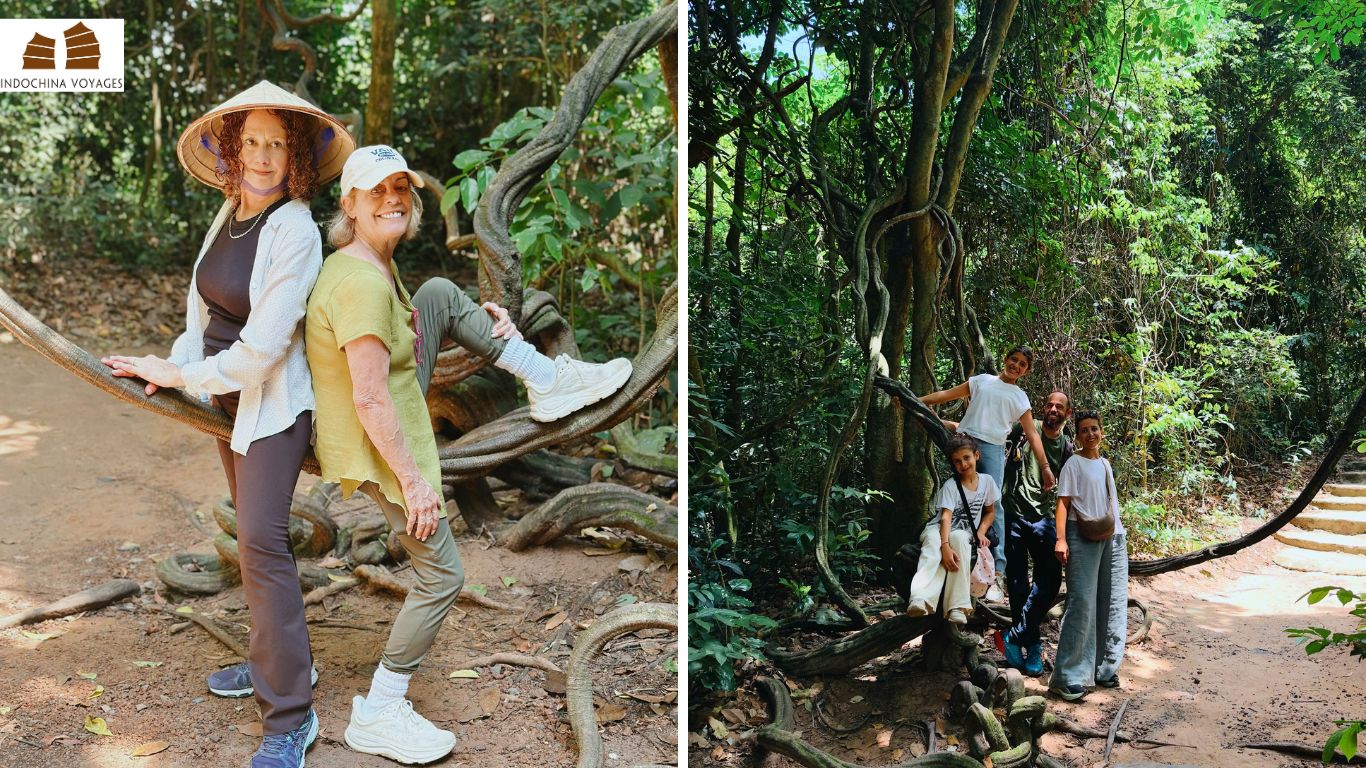
The Cu Chi Tunnels are located in Cu Chi District, on the rural northwestern outskirts of Ho Chi Minh City (formerly Saigon), Vietnam. Depending on which of the two visitor sites you choose – Ben Dinh or Ben Duoc, the tunnels sit roughly 43 to 70 kilometers from central Ho Chi Minh City, with travel time of about 1 to 1.5 hours by car.
Plan for longer during weekday mornings: traffic on Highway 22, the main route out of the city, can be significant during rush hour. Most organized tours depart between 7:30 and 8:00 AM specifically to beat both the traffic and the worst of the afternoon heat.
How to Visit Cu Chi Tunnels From Saigon?
You have a few ways to get there:
- Self-drive / Grab taxi: Doable, and it gives you full control of your schedule. You can explore the grounds independently, though a guide is still required to actually enter the tunnel sections (more on that below).
- Public bus: Bus 13 from Ben Thanh to Cu Chi Bus Station, then Bus 79 to the site. Cheapest option, but slow (2.5-3 hours each way) and you won’t have a guide once you arrive.
- Group tour: The most common choice, a shared coach with a fixed departure time, fixed pace, and a guide split across 15-20 people.
- Private tour: A dedicated vehicle and guide on your own schedule, the better fit if you’re traveling with a mix of ages (grandparents and grandkids on the same trip, for example) or simply don’t want to be herded through the site at a group’s pace.
We run private Cu Chi Tunnels day trips built around your group’s pace and interests – see the private tour option.

So, Are Cu Chi Tunnels Worth Visiting?
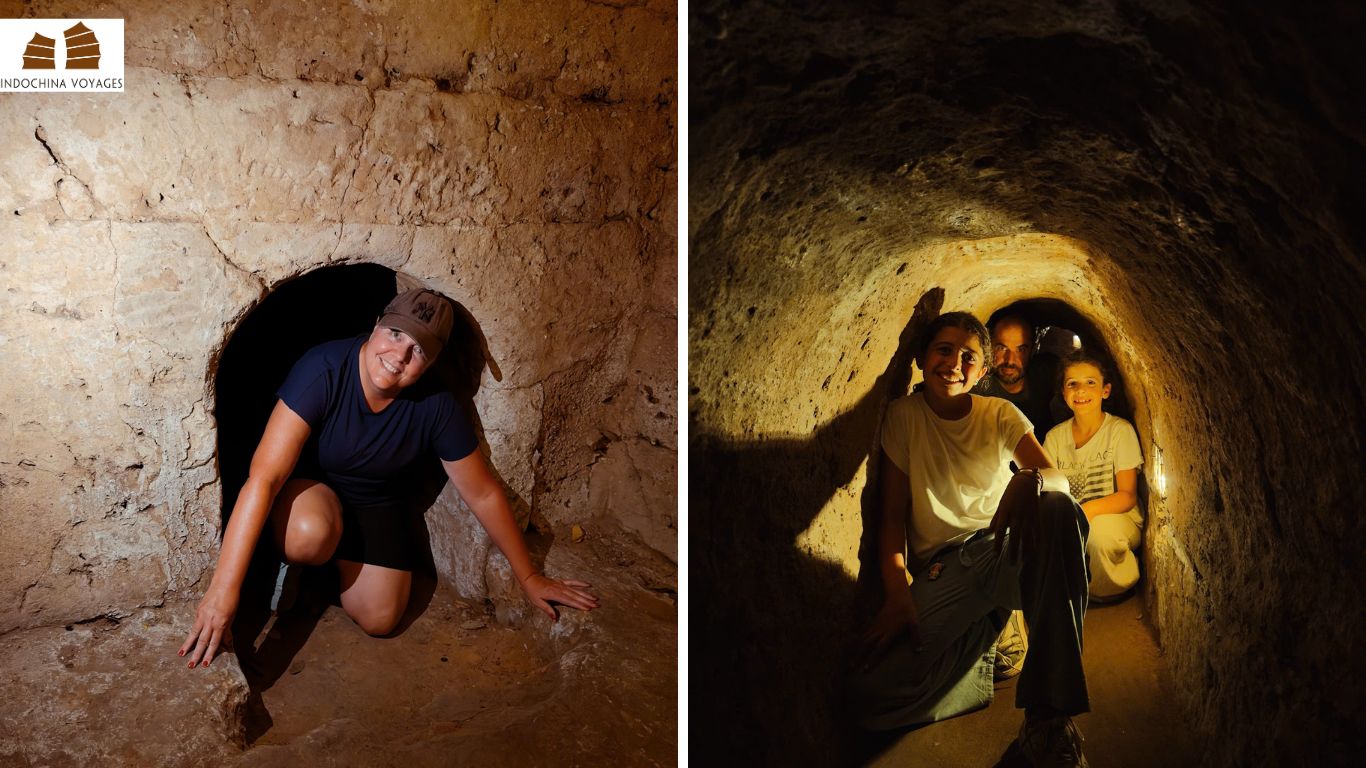
Yes, genuinely, and not just because they’re famous. The Cu Chi Tunnels are one of the few historical sites in Vietnam where the physical experience itself teaches you something that words and photographs cannot. Crawling through a section of tunnel, even one that’s been widened for tourists, gives you an immediate, visceral sense of scale, darkness, and physical endurance that no museum exhibit can replicate.
For travelers with an interest in the Vietnam War (known in Vietnam as the American War), this site is essential. For those less drawn to military history, the engineering achievement alone – 250 kilometers of hand-dug tunnels built with basic tools, sheltering entire communities under sustained bombing is remarkable enough to justify the visit.
The site is well-maintained, professionally guided, and easy to combine with other Ho Chi Minh City attractions. If your itinerary allows for only one day trip from the city, this is the one to prioritize.
Ready to add it to your Vietnam itinerary? We build private Cu Chi Tunnels days around your group’s pace – start planning with us.
>>> Related reading: What Are the Best Day Trips from Saigon – And Are They Worth It?
What to Expect at Cu Chi Tunnels?
A standard visit includes:
- A short introductory documentary explaining the tunnels’ history and significance
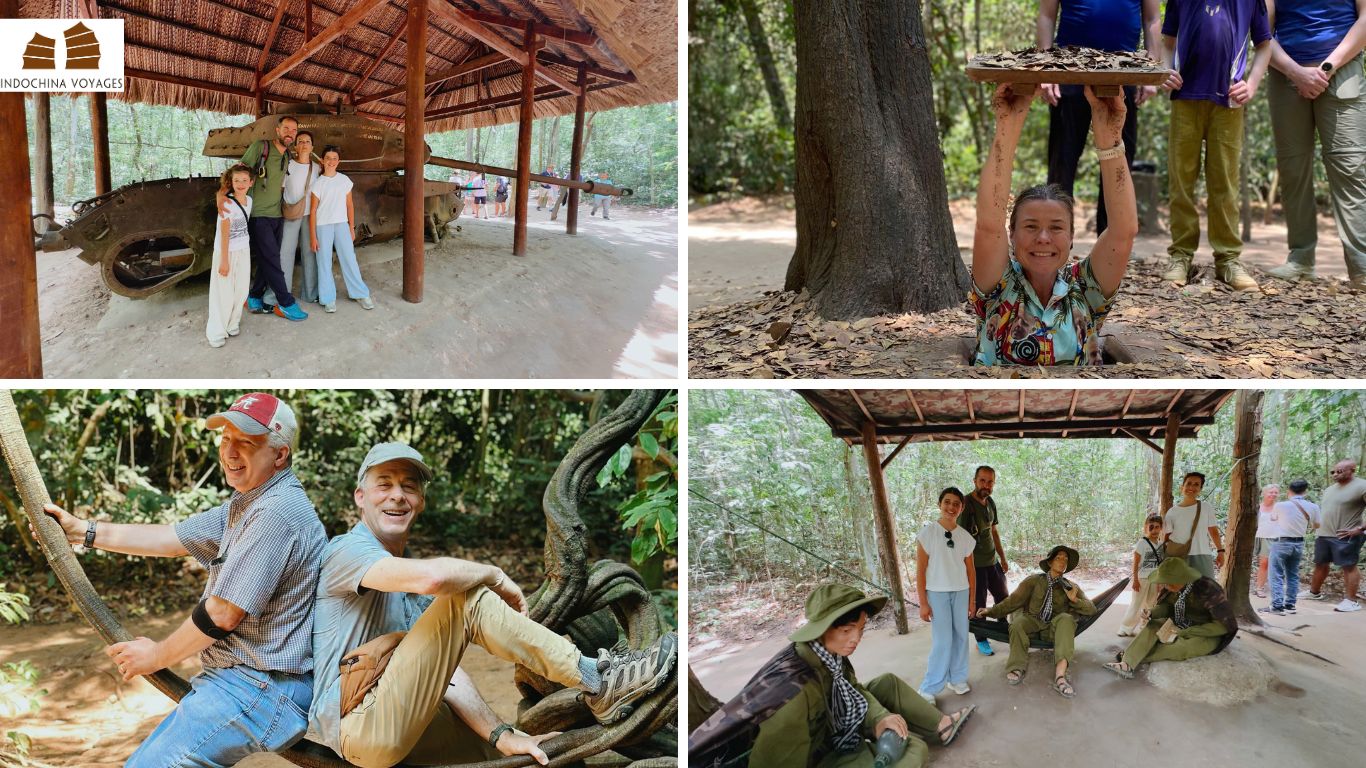
- A guided walk through jungle paths, with demonstrations of booby traps, camouflaged tunnel entrances, and defense mechanisms
- The chance to join other tourists crawling through the tunnels in a 100-150 meter section that’s been widened for visitor access (optional, but highly recommended)
- Displays of wartime weapons, equipment, and reconstructed underground rooms
- Samples of tapioca and pandan tea – the wartime diet of tunnel inhabitants
- An optional live weapons firing range (additional cost, and skippable)
Do You Need a Guide for Cu Chi Tunnels?
Yes, a guide is required to actually enter the tunnel network itself. You can walk the above-ground grounds independently, but access into the tunnels (at both Ben Dinh and Ben Duoc) is led by a guide as part of your ticket or tour. This isn’t a formality, the tunnel paths and jungle trails are genuinely easy to get disoriented in, and a knowledgeable guide is what turns a walk through the woods into an understanding of how the tunnel network actually worked.
With a group tour, that guide’s attention is split across 15-20 people. With a private guide, you get their full attention through the tunnels and trap demonstrations, useful if you have kids with questions, seniors who need a slower pace, or simply want to linger where you’re interested and move quickly past what you’re not.
The History – Why Were the Cu Chi Tunnels Built, and When?
Construction began in the late 1940s, during Vietnam’s resistance against French colonial rule. The Viet Minh dug the earliest passages by hand with rudimentary tools, initially covering just short distances between villages.
After the French departed, the tunnels took on new significance. As conflict with American and South Vietnamese forces intensified through the 1960s, the Viet Cong dramatically expanded the network. By the height of the Vietnam War, it stretched an estimated 250 kilometers, reaching from the outskirts of Saigon to the Cambodian border.
Why were they built? Originally for concealment and communication during the resistance against France, but as the network grew, it served several interlocking purposes:
- Command centers for planning military operations, including the 1968 Tet Offensive
- Living quarters for soldiers and, at times, entire families
- Storage for weapons, supplies, and food
- Field hospitals for treating the wounded
- Communication routes between villages and military bases
- Manufacturing workshops for weapons and traps
- Shelter during bombing campaigns
The tunnels were engineering marvels for the tools available at the time, featuring multiple levels from 3 to 10 meters deep, narrow passages sized to the smaller frames of Vietnamese fighters, air vents disguised as termite mounds, underwater river entrances, and numerous hidden trapdoors camouflaged with leaves and dirt. They proved central to Viet Cong guerrilla strategy, letting fighters control when and where battles occurred and significantly complicating American military efforts in the region.
Life inside the Tunnels
Life within the Cu Chi tunnel network was extraordinarily difficult. The conditions were harsh and dangerous, with soldiers and civilians enduring tremendous hardships while living underground.
The tunnels were perpetually hot, humid, and had limited ventilation. Breathing was difficult, and the air was often stale and foul. American soldiers coined the term “Black Echo” to describe the oppressive conditions inside.
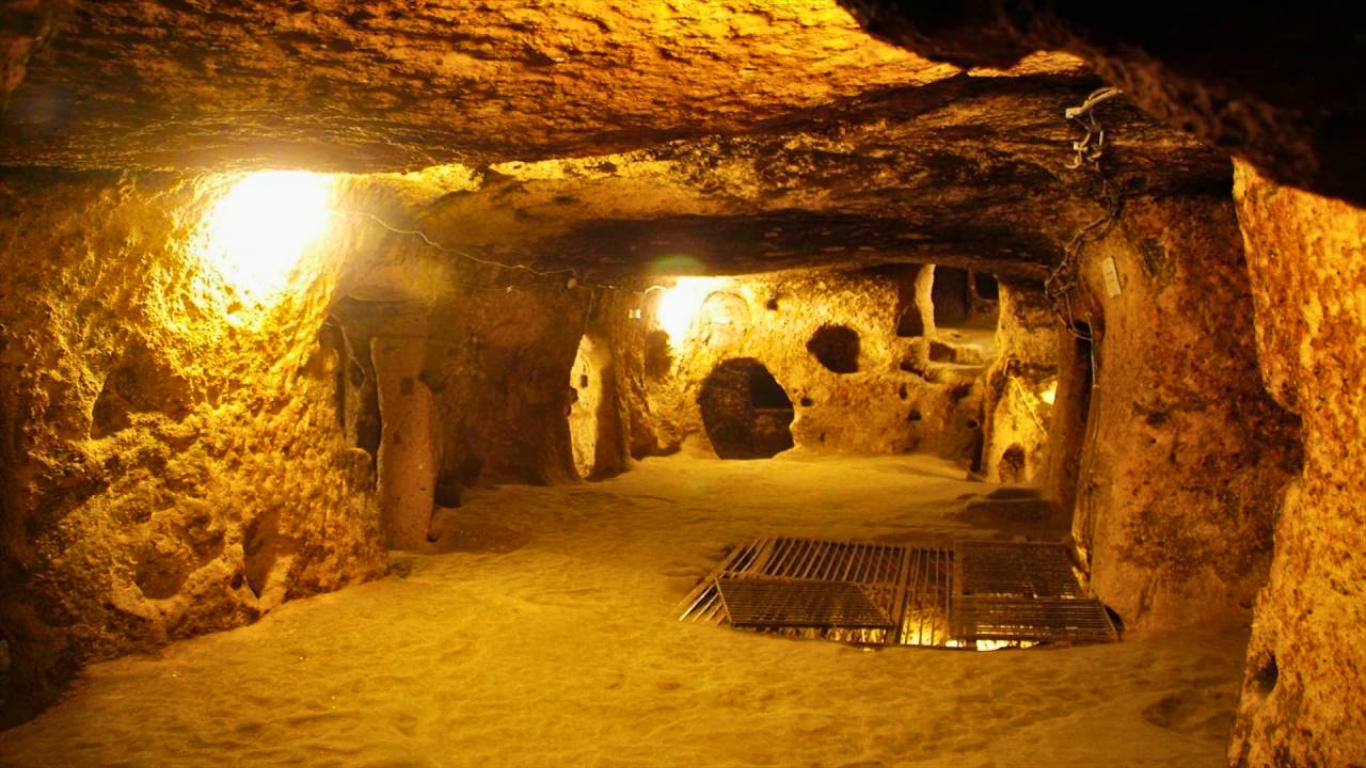
Space was extremely confined, with most tunnels measuring only about 80-120 centimeters (31-47 inches) high and 60-80 centimeters (24-31 inches) wide. People lived in cramped quarters, often unable to stand upright for days or weeks.
The darkness was nearly complete, with few light sources available. Residents would typically use small oil lamps sparingly to conserve fuel.
Disease was rampant, particularly malaria, which was the second-highest cause of death after combat wounds. According to captured reports, at any given time, up to half of a Viet Cong unit might be suffering from malaria, and virtually all had significant intestinal parasites.
The tunnel dwellers faced constant danger from:
- Cave-ins caused by bombing
- Poisonous gas pumped in by American forces
- Flooding during the rainy season
- Wildlife, including venomous centipedes, scorpions, snakes, and rats
Food was scarce and simple. The primary diet consisted of tapioca (cassava) and other easy-to-grow crops that could be cultivated near tunnel entrances. Most cooking was done at night or very early morning to prevent smoke from revealing tunnel locations.
For women, life was especially challenging during menstrual periods, with limited hygiene options and no ability to leave the tunnels during heavy bombing campaigns.
Despite these extreme conditions, the tunnel inhabitants displayed remarkable resilience and ingenuity. They developed systems for water collection, created designated areas for different activities, and established routines that allowed them to survive for years in this underground world.
The Booby Traps
One of the most infamous aspects of the Cu Chi Tunnels was the extensive use of booby traps. These were designed not necessarily to kill but often to maim and wound, which would require more resources from the enemy to care for injured soldiers.
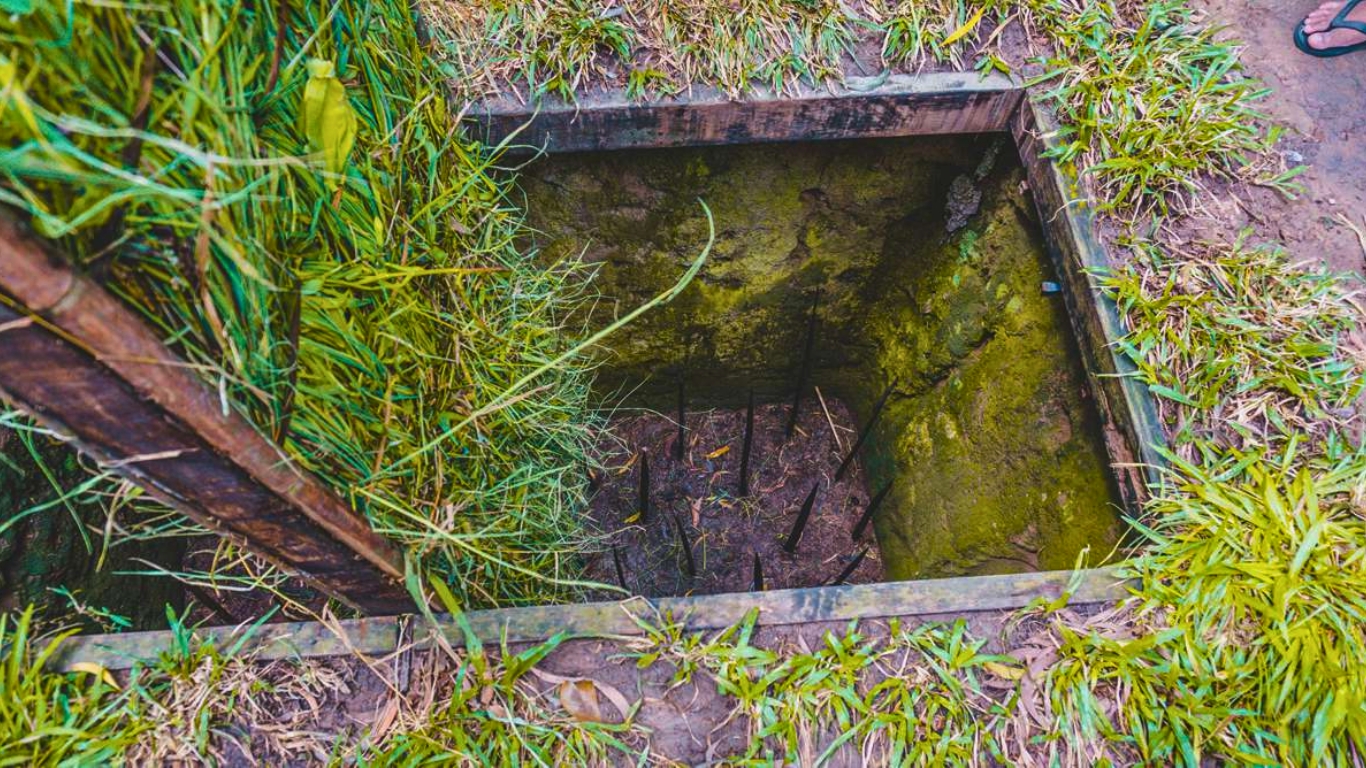
The Viet Cong created these deadly devices using simple materials, often recycling metal from unexploded American bombs and artillery shells. Some of the most common traps included:
- Punji Stake Pits: Concealed holes filled with sharpened bamboo stakes, sometimes smeared with animal feces to cause infection in wounds.
- Swinging Door Traps: Spring-loaded devices with metal spikes that would slam into an intruder’s torso when triggered.
- Ankle Traps: Hidden mechanisms that would clamp around a soldier’s foot, often embedded with spikes.
- Drop Traps: Camouflaged pits with sharp spikes at the bottom, designed to impale anyone who fell in.
- Tripwire Traps: Nearly invisible wires that, when tripped, would release spikes, arrows, or other projectiles.
The psychological impact of these traps was significant. American soldiers had to move cautiously through the jungle, creating constant stress and fear. The guides at Cu Chi today often demonstrate how these various traps worked, giving visitors a sobering understanding of the guerrilla tactics employed during the war.
Ben Dinh vs. Ben Duoc: Which site should you visit?
| Ben Dinh | Ben Duoc | |
|---|---|---|
| Distance from HCMC | 43-50 km (1-1.5 hrs) | 50-70 km (1.5-2 hrs) |
| Site size | ~17 hectares | ~100 hectares |
| Crowd level | Higher | Lower |
| Tunnel width | Wider (more tourist-friendly) | Narrower (more authentic) |
| Entrance fee | 110,000 VND | 110,000 VND |
| Extra highlight | — | Memorial temple honoring Vietnamese soldiers |
| Best for | Limited time, group tours, first-time visitors | Fewer crowds, history enthusiasts, immersive experience |
| Our pick | If short on time | If experience matters more |
Our recommendation: If your schedule allows the extra travel time, Ben Duoc consistently receives stronger reviews for atmosphere and authenticity. If you’re joining a standard group tour from the city center, most will go to Ben Dinh, still a worthwhile visit, just expect more visitors around you.
Unique Experiences When Visiting
A visit to the Cu Chi Tunnels offers several unique experiences you won’t find elsewhere:
– Crawling Through the Tunnels: Perhaps the most memorable experience is the opportunity to crawl through a 100-150 meter section of tunnel that has been specially widened for tourists. Even these enlarged sections remain challenging and give visitors a taste of the claustrophobic conditions. Most people emerge with newfound respect for those who lived in the much narrower original tunnels.
– Firing Historic Weapons: The site features a shooting range where visitors can fire various weapons used during the Vietnam War, including AK-47s, M16s, and machine guns. While this costs extra (around 55,000-60,000 VND per bullet with a minimum purchase of 10 bullets), many visitors find it a unique, if loud, experience.
– Sampling Wartime Foods: Visitors are often offered steamed tapioca with sesame salt and pandan tea – the same simple fare that sustained the Viet Cong soldiers during the war.
– Watching Documentary Films: Several viewing huts at the site show documentary footage about the war and the tunnels. These provide important historical context, though many guides now recommend specific YouTube videos they believe offer more balanced perspectives.
– Trying to Spot Camouflaged Entrances: Guides demonstrate how tunnel entrances were disguised, often challenging visitors to spot the almost invisible trap doors before they’re revealed.
– Witnessing the Breathing Mounds: You can see the camouflaged ventilation mounds that provided air to the tunnels below, ingeniously disguised to look like termite hills or natural terrain features.
Is Cu Chi Tunnels a Good Fit for Families, Kids, and Seniors?
Cu Chi Tunnels is one of the more manageable historical sites in Vietnam for mixed-generation groups – mainly because almost everything below-ground is genuinely optional.
For kids: Most guides consider the site a good fit from around age 7-8 up, once children can process the historical context and follow safety instructions. Younger kids can still enjoy the forest walk and above-ground exhibits even if the tunnel crawl isn’t for them. Loud sounds are limited to the optional shooting range, which is easy to skip or watch from a distance.
For teens: This tends to land well with teenagers specifically, since it’s hands-on rather than a standard museum walkthrough, the crawling, trap demonstrations, and optional weapons range usually hold their attention better than a gallery of exhibits would.
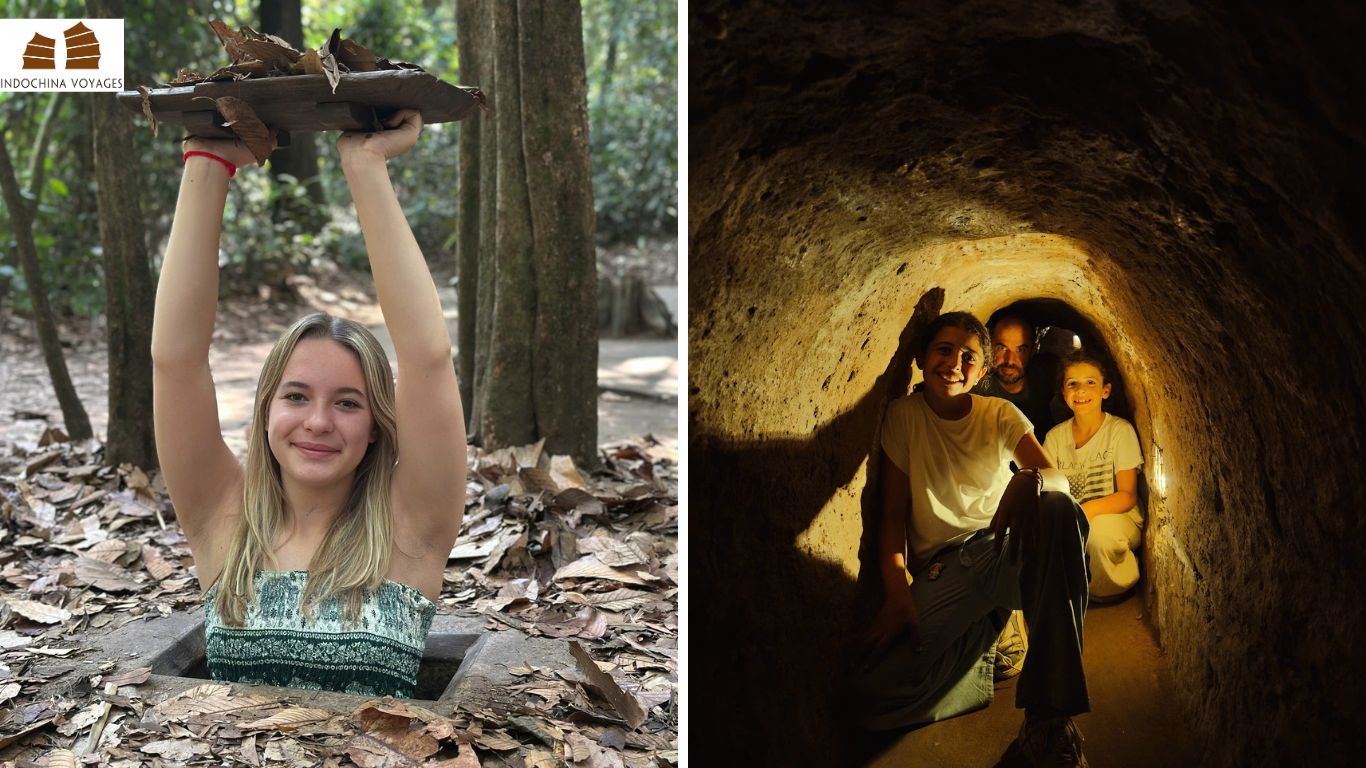
For seniors and anyone with mobility concerns: The forest paths are shaded but uneven in places (packed dirt, tree roots), so comfortable, closed-toe shoes matter more than overall fitness. The tunnel crawl requires crouching and kneeling and isn’t recommended for anyone with knee, back, or breathing issues, but skipping it doesn’t mean skipping the site. The above-ground exhibits (weapons displays, reconstructed rooms, the documentary, tapioca tasting) cover most of the same historical ground.
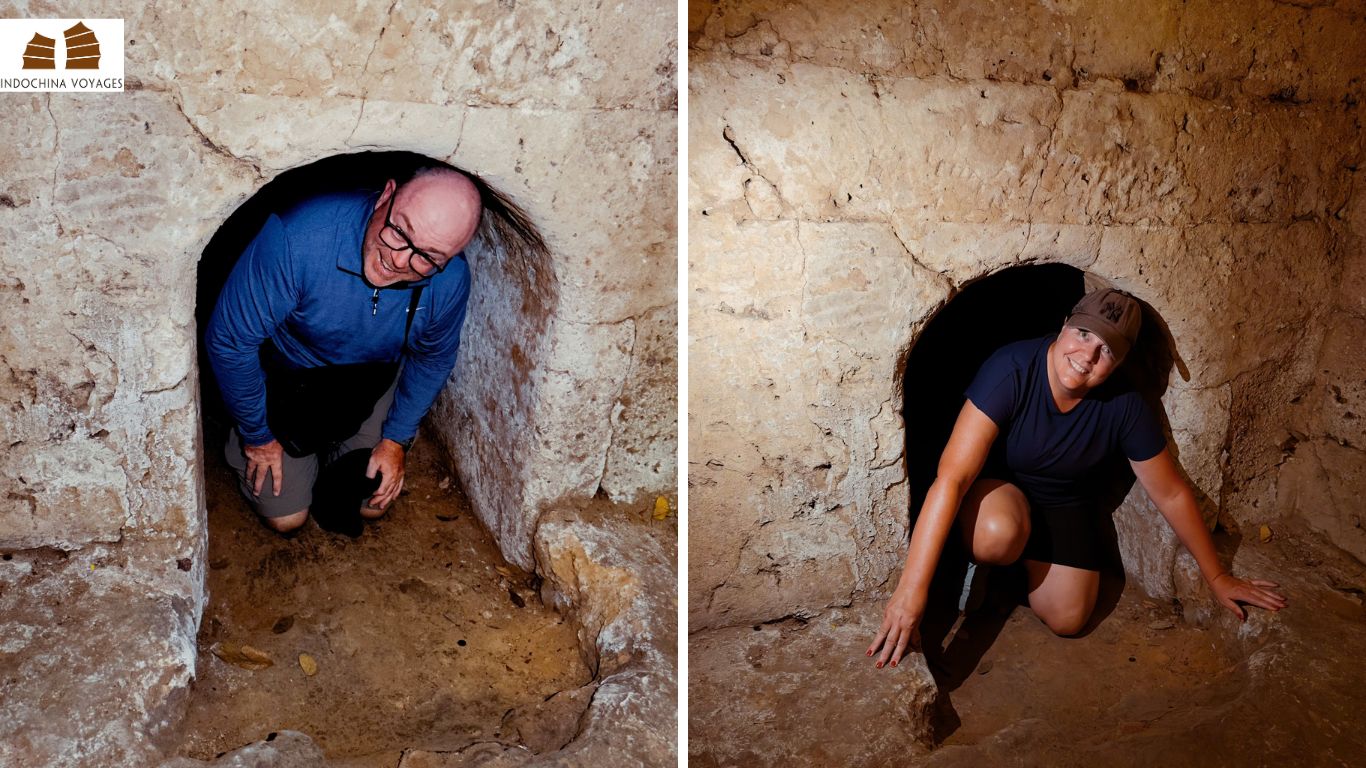
The practical upside of a private guide here: a fixed-departure group tour moves at one pace for everyone. A private guide can let grandparents linger at the shaded exhibits while the kids do the tunnel crawl, without anyone waiting on anyone else.
Traveling with a mix of ages? Get our advice for a private tour to Cu Chi tunnels or further Vietnam here!
Suggested Cu Chi Tunnels Day Trip
There are several ways to incorporate the Cu Chi Tunnels into your Vietnam itinerary. Here are two excellent options:
Option 1: Half-Day Cu Chi Tunnels Experience
Morning: Depart for your late morning flight to Ho Chi Minh City, formerly known as Saigon, the vibrant Pearl of the Far East.
Midday: Upon arrival, you will be picked up and driven out of the bustling city to the Cu Chi Tunnels. These remarkable tunnels were manually excavated by Viet Cong soldiers, serving as a secret military base during the Vietnam War. This site is essential for anyone interested in learning about the history of the Vietnam War.
Afternoon: After your visit, return to the city in the late afternoon to check into your hotel. Take some time to explore the vibrant streets and local attractions at your leisure.
Option 2: Combined City Tour and Cu Chi Tunnels
Morning: Breakfast and City Tour
Enjoy breakfast at your hotel. At 8:15 AM, embark on a half-day city tour of Ho Chi Minh City. Highlights of the tour include:
- The Old Post Office: An architectural gem reflecting French colonial style.
- Notre Dame Cathedral: A stunning basilica surrounded by lush greenery.
- Independence Hall: A pivotal site in Vietnam’s history.
- War Remnants Museum: A powerful reminder of the Vietnam War.
- Ben Thanh Market: Experience the hustle and bustle of this iconic marketplace.
Afternoon: Lunch and Cu Chi Tunnels
- After the city tour, enjoy lunch at a local restaurant in the heart of Ho Chi Minh City.
- Following lunch, travel to Cu Chi District to visit the famous historical site, the Cu Chi Tunnels. Explore the intricate network of underground tunnels used by Viet Cong and guerilla fighters during wartime.
Late Afternoon: Return to Saigon
- Walk along the narrow paths of the tropical forest in Cu Chi to witness remnants of the Vietnam War, gaining insight into its impact on the region.
- After your exploration, return to your vehicle for the drive back to Saigon in the late afternoon.
>>> For off-beat seekers: Saigon Off the beaten path: Top 15 Offbeat Activities for Curious Travelers
Before You Go
Here is some information that may be helpful for you before going:
Opening Hours & Entrance Fee
- The Cu Chi Tunnels are open daily from 7:00 AM to 5:00 PM (including public holidays)
- Entrance fee: Approximately 110,000 VND for adults (about $4-5 USD)
- Guided tours typically cost $20-30 USD, including transportation from Ho Chi Minh City
Are The Cu Chi Tunnels Claustrophobic?
Yes, the tunnels can definitely trigger claustrophobia, even in the sections that have been widened for tourists. The original tunnels were extremely narrow, and even the enlarged tourist sections require crouching and crawling in dim lighting. If you have claustrophobia, consider these options:
- You can still visit and enjoy most of the site without entering the tunnels
- Try entering just a short distance and then turning back
- There are multiple exit points along the tourist tunnel routes
What to Wear to Cu Chi Tunnels?
- Closed-toe shoes – sneakers, not sandals. You’ll be crouching, crawling, and walking uneven forest paths.
- Breathable, muted-color clothing – it’s hot and humid year-round, and light or white fabric shows dirt fast if you go into the tunnels.
- A light layer for the vehicle ride – the gap between outdoor heat and air-conditioned transport is a common comfort complaint.
- Clothes you don’t mind getting dusty – the crawling sections involve real dirt contact, not a sanitized “tourist” version.
- Insect repellent applied before you arrive – the site is surrounded by jungle.
Can You Go Inside The Cu Chi Tunnels?
Yes, visitors can go inside sections of the tunnels that have been specifically prepared for tourism. These sections have been:
- Widened from the original 60-80cm to about 120cm
- Reinforced with concrete for safety
- Equipped with dim lighting
- Provided with exit points at regular intervals
However, even these modified sections can be challenging to navigate and require a moderate level of fitness. If you have mobility issues, respiratory problems, or severe claustrophobia, you might want to skip the tunnel crawling portion of the tour.
Additional Tips
- Bring water – it’s hot and humid year-round
- Book a morning departure to beat both traffic and afternoon heat
- Bring small bills for entrance, souvenirs, and the shooting range if you’re interested
- Book with a reputable operator – a knowledgeable guide makes a significant difference to the experience
The Cu Chi Tunnels represent an important chapter in Vietnam’s history and offer visitors a unique opportunity to understand the ingenuity, hardship, and determination that characterized this period. While the journey there might be lengthy and some aspects challenging, particularly for those with claustrophobia or mobility issues, the historical significance and educational value make it well worth the visit for most travelers to Ho Chi Minh City.
Planning a Vietnam trip with a mix of ages, or just want your Cu Chi day handled without the group-tour shuffle? Contact our team or email at info@indochinavoyages.com to build a private day trip around your pace.