
Con Dao or Phu Quoc? It is one of the most common island questions we hear from travelers planning Vietnam tours through the south, and the honest answer is that neither is better. Phu Quoc is the easy, varied, resort-style island, with direct flights from several Asian cities and plenty to do beyond the beach. Con Dao is the quieter, wilder one, reachable only by domestic flight or ferry, and known for marine nature, diving and some of the most significant history in the country. This guide compares them on what actually decides a trip: how to get there, when to go, what you will do and what it costs.
Quick Answer: Con Dao vs Phu Quoc at a Glance
Choose Phu Quoc if you want: international-standard resorts, vibrant nightlife, theme parks, a variety of water sports, and easy access from around the world.
Choose Con Dao if you want: untouched beaches, some of Vietnam’s best snorkeling and diving, sea turtle nesting season, real historical depth, and a genuinely quiet, low-crowd island.
If time and budget allow, combining both islands into one Vietnam trip gives you the best of both worlds.
Con Dao vs Phu Quoc: Main Differences at a Glance
The two islands sit in different corners of southern Vietnam and feel like different holidays. Phu Quoc, in the Gulf of Thailand near the Cambodian border, is large, developed and built around visitors. Con Dao, a small protected archipelago in the South China Sea about 230 km from Ho Chi Minh City, is remote and deliberately low-key.
| Factor | Phu Quoc | Con Dao |
|---|---|---|
| Best for | Resort holidays, families, varied activities | Nature, diving, history, quiet escapes |
| Atmosphere | Lively and well developed, with night markets and resort entertainment | Relaxed, small-scale, early nights |
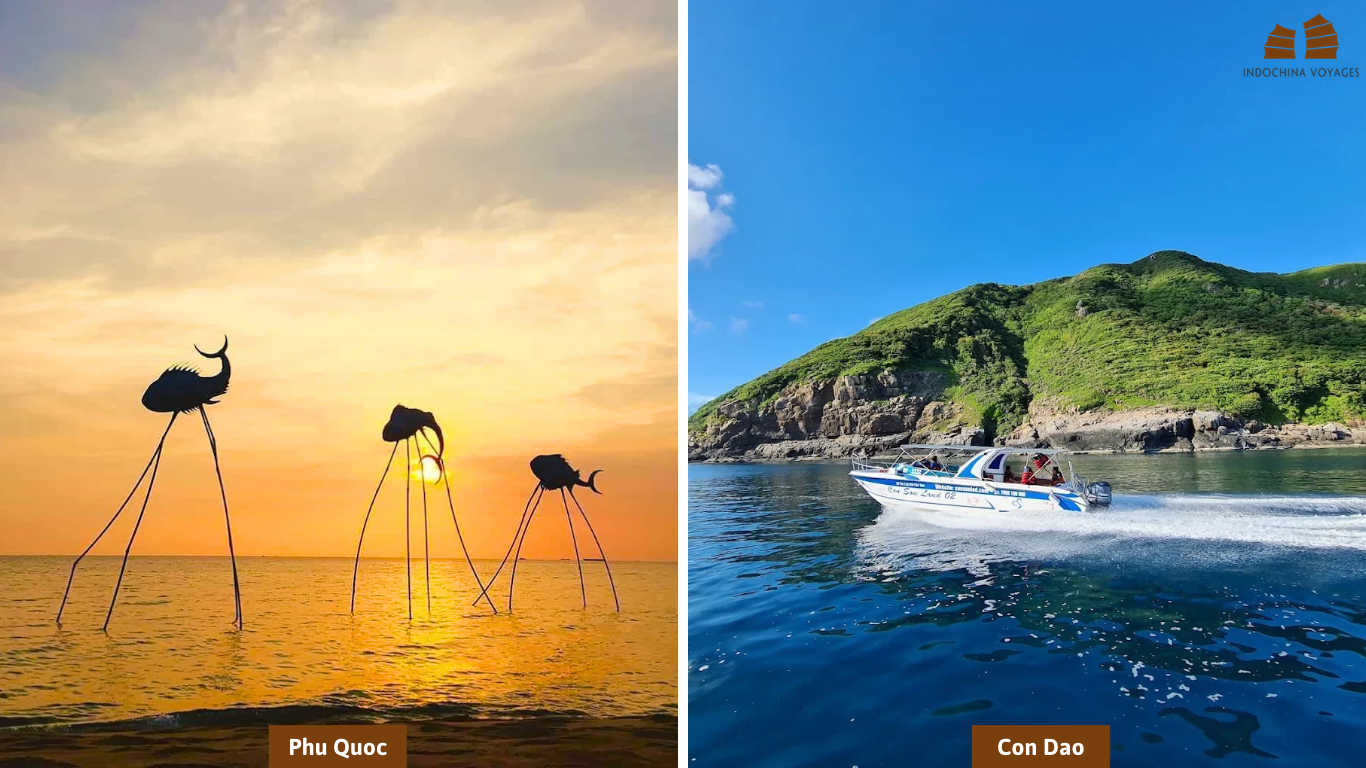
| Beaches | Long Beach, Ong Lang, Bai Sao and Bai Khem, most with resorts nearby | Dat Doc and Dam Trau on the main island, plus quiet bays and offshore islets reached by boat |
| Signature experiences | Island hopping around the An Thoi archipelago, Hon Thom cable car, night squid fishing | Turtle nights on Bay Canh, diving at Hon Tai and Bay Canh, the prison and cemetery sites |
| Accommodation | Guesthouses to international five-star resorts | A small stock, from fan-cooled guesthouses to a few luxury resorts |
| Flights | Domestic flights plus direct international routes, including Taipei, Singapore, Bangkok and Kuala Lumpur | Domestic only, mainly from Ho Chi Minh City; no international flights |
| Sea routes | Ferries from Ha Tien (about 1.5 hours) and Rach Gia (about 2.5 hours) | Ferries from Tran De (about 2.5 hours), Vung Tau (about 3.5 hours, limited sailings) and Ho Chi Minh City (about 5 hours) |
| Best time | November to April for beaches, peaking December to February | November to April for calm seas; turtles April to October; diving March to September |
| Time needed | 3 to 4 nights | 2 to 3 nights, more for diving or turtles |
Which Island Fits Your Travel Style?
Choosing by travel style is usually more useful than comparing attractions one by one, because the two islands reward very different kinds of travelers.
Phu Quoc for resorts, families and variety
Phu Quoc suits travelers who want a proper beach holiday with plenty to do beyond the hotel: beachfront resorts with pools and spas, a wide choice of restaurants, boat trips, night markets and evening entertainment. The island is roughly 50 km end to end, so your base matters more than the star rating.
- Long Beach and Duong Dong: the safe first choice. Restaurants, shops and the airport are close, though the northern stretch of Long Beach is the busiest part of the island.
- Ong Lang: a quieter coast about 15 minutes north of Duong Dong, with rocky and sandy coves, clearer water and spread-out resorts. Shops are a few kilometers away, so you will want a scooter or a car.
- Bai Sao, Bai Khem and An Thoi in the south: the postcard beaches, the luxury resorts and the departure point for island-hopping boats. Expect a 30 to 40 minute transfer from the airport and town.
Book early for December to February, when many rooms sell out, and book online instead of walking in, as walk-in rates are often 20 to 30 percent higher.
>>> Related reading: Phu Quoc Tourism: A Comprehensive Travel Guide To Paradise Island
Con Dao for nature, marine life and history
Con Dao suits travelers who are comfortable with fewer facilities in exchange for a calmer atmosphere. Nearly all visitors stay on the main island, Con Son, in or near the small town. From there you reach forested hills, quiet beaches, offshore islets with good diving and a serious historical side centered on the former prison complex. It rewards advance planning and a slower pace. Evenings are quiet and restaurants close early, so treat the island as a place to be up at dawn rather than out late.
Couples, families, older travelers and divers
- Couples who want resort comfort should look at Phu Quoc, while those after a quiet, nature-focused retreat will prefer Con Dao.
- Families usually find Phu Quoc easier, thanks to entertainment, convenient facilities and plenty of places to eat. Con Dao works well for families with older children who enjoy nature and history.
- Older travelers who value comfortable accommodation and simple transfers will find Phu Quoc more straightforward. Con Dao also works, provided you fly rather than take the ferry.
- Divers and snorkelers should lean toward Con Dao for its marine focus, particularly from March to September.
Who should skip which? Skip Phu Quoc if crowds, traffic and development will bother you. Skip Con Dao if you want nightlife, shopping or a long list of things to do each day, or if your trip has no flexibility for weather-related transport changes.
How to Get to Con Dao and Phu Quoc
Transport is where the two islands differ most, and it should shape your decision as much as the beaches do.
Getting to Phu Quoc
Phu Quoc has an international airport and the best air connections of the two. Sun PhuQuoc Airways, the island’s home carrier, flies up to seven times a day from Ho Chi Minh City and up to five times a day from Hanoi, with daily Da Nang flights from March 2026. In 2026 it also began direct international routes: Taipei from March 29, Singapore from July 25, Bangkok from August 8 and Kuala Lumpur from September 1, with more planned. Vietnam Airlines and Vietjet also serve the island.
The sea route is the alternative. Fast ferries run from Ha Tien in about 1 hour 15 minutes to 1 hour 45 minutes and from Rach Gia in about 2 hours 15 minutes to 2 hours 45 minutes, operated mainly by Superdong and Phu Quoc Express. Boats dock at Bai Vong or Ham Ninh on the east coast. Flying is simpler for most travelers, while the ferry makes sense when you are already in the Mekong Delta or arriving overland from Cambodia via Ha Tien.
One point that matters for combined trips: Phu Quoc’s 30-day visa exemption applies to stays on the island itself. If you add Con Dao or other mainland stops, check the entry rules for your nationality before you book.
>>> Related reading: How To Navigate from Phu Quoc to Siem Reap? – Complete Moving Instruction
Getting to Con Dao
Con Dao is harder to reach, which is part of its appeal.
- By air: VASCO (Vietnam Airlines group) flies small ATR-72 turboprops from Ho Chi Minh City and Can Tho, and Vietjet flies from Ho Chi Minh City and Hanoi. Ho Chi Minh City has by far the most frequent service, with around ten flights a day on the 2026 timetable. The airport is small and operates in daylight only, with return flights leaving Con Dao roughly between 6:30am and 5pm. There are no international flights.
- By ferry from Tran De: the shortest sea crossing, around 2 hours 15 minutes to 2 hours 30 minutes with Superdong. Tran De is in the Mekong Delta and now falls under Can Tho City. Fares run from roughly 370,000 to 590,000 VND depending on the vessel and seat.
- By ferry from Vung Tau: a catamaran of around 3.5 hours. The route restarted in February 2026 after a pause for vessel repairs and currently runs only a few sailings a week, so confirm the timetable before building a plan around it.
- By ferry from Ho Chi Minh City: Phu Quy Express runs a direct service of about 5 hours.
- Weather matters: swell can suspend ferries at short notice, even when no storm is nearby. If your dates are fixed, fly.
Because flight seats and rooms are limited, book transport and accommodation early for Con Dao, especially for the turtle season and holidays.
>>>> Related reading if you take the Tran De route through the Mekong Delta:
Can you visit both islands in one trip?
Yes, but there is no direct link. The practical route is Phu Quoc to Ho Chi Minh City, then a flight to Con Dao. Door to door, expect 6 to 10 hours depending on connections, so treat it as a travel day rather than a transfer. A land-and-sea route via Rach Gia, Can Tho and Tran De covers about 430 km and takes longer still.
Our advice is to finish on Phu Quoc, because it has direct international flights and Con Dao does not. Con Dao’s flights run in daylight only, so avoid booking an international departure on the day you leave Con Dao; sleep in Ho Chi Minh City first. This pairing also works well at the end of a longer Vietnam tour, with culture first and the beach last.
>>>> Not sure how to connect the two islands? Tell Indochina Voyages your dates on this page and we will plan the flights and ferries around them.
Best Time to Visit Con Dao or Phu Quoc
The two islands do not share an identical seasonal pattern, and this is where many guides go wrong.
Phu Quoc
The dry season, roughly November to April, is the main window for beach holidays, with calmer seas and more reliable boat trips. December to February is the peak, with the highest prices and many rooms sold out. From May to October it is wetter, and rain and sea conditions can disrupt excursions. Travelers who visit in the wet months should keep boat days flexible and choose a resort with good facilities for rainy afternoons.
>>> Related reading: Best Time to Visit Phu Quoc: When Pristine Beaches & 300+ Sunny Days Await
Con Dao
Con Dao has a trade-off that Phu Quoc does not. The dry season, roughly November to April, is best for beaches, hiking and the prison sites. But diving is at its best from around March to September, and sea turtles nest from about April to October, peaking between May and September. Hatchling releases tend to fall late in the season, from roughly July to September. Those are also the rainiest months, with September bringing rain on about half of all days. Treat Con Dao as a wildlife-and-diving destination in the middle of the year and a beach-and-hiking destination in the dry months.
Turtle watching is a conservation activity, not an attraction, and sightings are never guaranteed. All turtle tours are organized by Con Dao National Park, you must register in advance, and groups are capped at 24 visitors. Nesting can be observed from 6pm to 6am and hatchling releases take place between 5:30am and 7:30am. Flashlights and camera flash are restricted. The overnight stay on Bay Canh Island is the most sought-after option and sells out in the peak months, so book several weeks ahead. Expect to pay roughly 1.8 to 3.5 million VND per person depending on the package.
Which island is better for your travel month?
| Period | Phu Quoc | Con Dao |
|---|---|---|
| November to April | Best for beaches: calm seas, reliable boat trips, busiest and priciest from December to February | Dry and calm, good for beaches, hiking and prison visits; diving improves from March |
| May to October | Wetter, with variable seas and some disrupted excursions | Peak turtle season and good diving, but more rain; better for wildlife and divers than for beach seekers |
If you are traveling in the middle of the year and want a pure beach holiday, Phu Quoc is the more comfortable choice. If you want turtles or diving, Con Dao makes sense even in the rain.
Beaches, Activities and Nature
Phu Quoc beaches and activities
Long Beach is a 20 km strip on the west coast, busy and good for sunsets. Ong Lang is quieter, with rocky and sandy coves and clearer water. In the south, Bai Sao has the white sand and turquoise water people picture, and Bai Khem is home to the island’s most luxurious resorts.
The signature day out is a boat trip around the An Thoi islands in the south. Tours typically leave An Thoi between 8:00 and 8:30am, call at two or three snorkeling spots and a fishing village, and include hotel pickup, lunch and snorkeling gear. Popular stops include Gam Ghi, May Rut and Mong Tay. On land you can ride the cable car to Hon Thom, visit the Sunset Town and Grand World areas, walk forest trails in the national park, see pepper farms and fish sauce production, and visit Ho Quoc Pagoda, which is free to enter. After dark, join local fishermen for night squid fishing.

>>>> Related reading on Phu Quoc activities:
- Looking for Things to Do in Phu Quoc Beyond the Beach? Here’s What Most Travelers Miss
- Diving, snorkeling and boat trips in Phu Quoc
Con Dao beaches and activities
Con Dao’s appeal is in its quieter shores, forested scenery and surrounding islets. On the main island, Dat Doc and Dam Trau are the easiest beaches to reach. Many of the best sites are offshore and need a boat transfer or an organized excursion: Bay Canh, Hon Tai, Hon Cau and Hon Tre Lon. A standard snorkeling day visits Bay Canh, where you can also climb to the old lighthouse and walk the mangroves.
On land, hiking trails start from the national park office just outside town. The trail to So Ray viewpoint gives wide views over the town, coast and surrounding islands. Arrange guides and permits through the park office.

Which island is better for snorkeling and diving?
There is no single winner, and it depends on what you want.
- Phu Quoc is built around organized boat trips that are easy to add to a resort stay, and local operators also run dives around the An Thoi islands.
- Con Dao is the more serious marine destination. The park has more than 25 dive sites. Hon Tai is the closest, 5 to 10 minutes by boat, at 5 to 15 m and suited to beginners. Bay Canh, 10 to 15 minutes out at 5 to 18 m, is known for turtles and healthy reef. A small number of PADI operators run the sites, including Con Dao Dive Center, which has operated since 2013 and charges around 3.6 million VND (about US$138) for two dives, including gear, VAT and park fees.
Visibility and sea conditions depend on the site, weather and season, so match your dates to the diving calendar (March to September on Con Dao) before committing. Book dive boats at least a day ahead, as group sizes are small.
History and culture
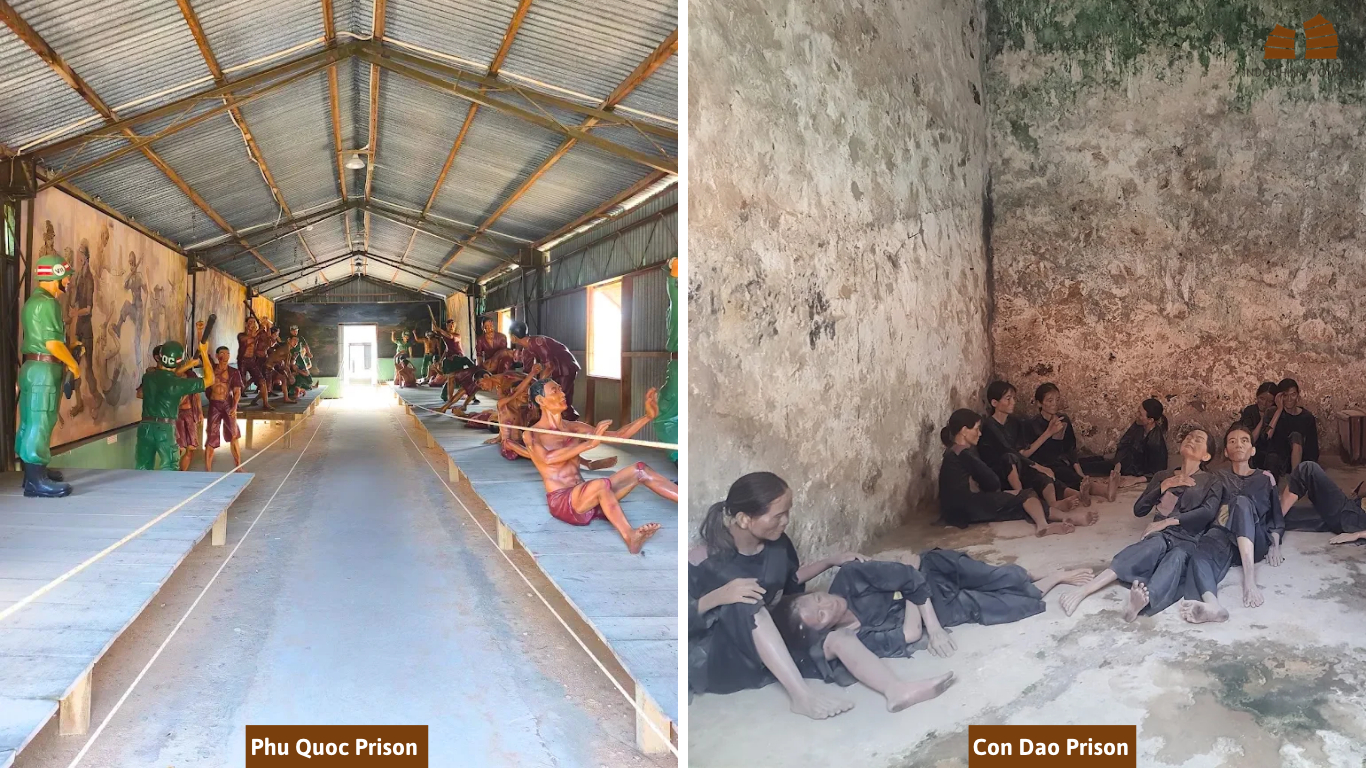
On Phu Quoc, you can visit Phu Quoc Prison in An Thoi, see fish sauce being made, wander through pepper farms and browse local markets. On Con Dao, the former prison system is the heart of the visit: the Phu Hai camp, the oldest; the French-era tiger cages at Phu Tuong; the American-era tiger cages at Phu Binh; and Hang Duong Cemetery, the resting place of thousands of prisoners. These are significant and moving places that give the island a depth Phu Quoc’s lighter cultural offering does not match.
Visit the Con Dao Museum first for context, go in the morning when it is cooler, and dress modestly at the cemetery. Sites close for a midday break, typically reopening around 1:30pm, so plan around it.
Evenings and dining
Phu Quoc has night markets, sunset bars, a wide choice of restaurants and resort entertainment. Con Dao is far quieter after dark. Most of its food other than seafood is imported, so meals cost more than on the mainland, and restaurants close early. Pick the island that matches the evenings you want.
Accommodation and Budget
Where to stay
Phu Quoc offers international-standard resorts, beachfront hotels, boutique properties and budget guesthouses, so it is easy to find something that fits your budget and preferred coast. Con Dao has a smaller range, from basic guesthouses in Con Son town to mid-range boutique resorts and a few high-end properties. Because supply is limited, book early for the peak months, and check the map on any listing: some Con Dao rooms advertised as beachfront are a 5 to 10 minute walk from the water. When booking a budget room, ask about hot water.
Where costs differ
Both islands are more expensive than the mainland, because goods and people arrive by sea or air. The figures below are indicative 2026 prices that vary by season and operator.
Phu Quoc
- Five-star resorts start from roughly 2.75 million VND (about US$110) a night at the quieter Ong Lang end, and rise from there on Long Beach and in the south.
- An independent 2026 estimate puts daily spending, excluding flights, at around €35 for a shoestring trip, €75 for a comfortable one and €160 for high-end travel.
- Scooters cost about 100,000 to 180,000 VND a day, and short Grab rides in Duong Dong run 30,000 to 60,000 VND.
Con Dao
- Basic rooms in Con Son town start around 500,000 VND with a fan and 700,000 VND with air conditioning. Mid-range boutique rooms run about 1.2 to 2.2 million VND. Top-end resorts such as Six Senses start around US$400 and climb sharply in peak months.
- Flights from Ho Chi Minh City typically cost around US$40 to US$130 one way depending on date, which is often the biggest single cost. The Tran De ferry costs roughly 370,000 to 590,000 VND.
- On-island activities add up: two dives about 3.6 million VND, a turtle package 1.8 to 3.5 million VND, and a scooter about 190,000 VND a day.
Is Con Dao or Phu Quoc more expensive?
Phu Quoc’s broader supply makes it easier to manage different budgets, from guesthouses to luxury. Con Dao can look cheaper on room rates at the budget end, but its limited supply, imported food and the cost of getting there narrow the savings. For most travelers the difference comes down to accommodation standard and how many excursions you add.
How Many Days Do You Need?
- Phu Quoc: three to four nights is a good starting point for beaches, an island-hopping day and some sightseeing. Stay longer for relaxation, families or a wider range of activities.
- Con Dao: two to three nights covers the historical sites, beaches and some nature. Add a night for diving, hiking or a turtle package, and an extra buffer if you travel by ferry.
- Both islands: combine them if you can give each a proper stay and accept a connecting day. For a short beach break, choosing one island is usually more relaxing.
A seven-night split that works well is three nights on Con Dao followed by four on Phu Quoc. Fly from Ho Chi Minh City to Con Dao in the morning, return via Ho Chi Minh City and then fly on to Phu Quoc, where you can relax on the beach and leave on a direct international flight. Let the flight schedule, not the island order, decide the final sequence.
>>> Related reading: How to plan the best Vietnam itinerary 2 weeks
Want a ready-made route to start from?
Con Dao or Phu Quoc: Which Island Should You Choose?
Choose Phu Quoc if you want resort comfort, a wide choice of activities and restaurants, and an energetic atmosphere. Choose Con Dao if you want quiet scenery, marine nature and meaningful historical experiences. If you have the time and the right transport connections, visit both. Whichever you pick, plan your transport and accommodation early, especially for Con Dao.
We have helped travelers discover both islands for many years. If you would like a tailor-made route that fits either island, or both, into your wider Vietnam journey, browse our Indochina travel packages. Prefer email? Write to info@indochinavoyages.com.