
Laos vs Cambodia is less a contest than a question of what kind of trip you want. Cambodia is organized around Angkor, Khmer history, lively cities and a southern coastline. Laos is built around mountains, the Mekong River, waterfalls and a Buddhist culture that moves at a slower pace. Neither country is better in general. The right choice depends on how much time you have, what holds your interest, and how you like to travel.
Quick answer: Choose Cambodia for Angkor, history and a coastline within one itinerary. Choose Laos for mountain scenery, river journeys and a calmer rhythm. If you have ten days or more and a workable flight, combining the two is the strongest option.
>>>> Browse our ready-made Cambodia tours, Laos tours, or Vietnam tours.
Laos vs Cambodia: key differences at a glance
The table below is a broad orientation, not a ranking. Each row is expanded in the sections that follow.
| Laos | Cambodia | |
|---|---|---|
| Best known for | Mountains, waterfalls, the Mekong, Buddhist heritage | Angkor temples, Khmer history, islands, lively cities |
| Atmosphere | Relaxed, nature-focused, unhurried | Varied, from historic towns to busy cities and beaches |
| Signature destination | Luang Prabang | Siem Reap and Angkor |
| Nature highlights | Kuang Si Falls, Vang Vieng, Bolaven Plateau | Tonle Sap Lake, Cardamom Mountains, southern islands |
| Khmer-era heritage | Wat Phou, near Champasak in the south | Angkor Wat, Bayon, Ta Prohm |
| Nightlife | Generally quieter: night markets, riverside venues | More choice in major tourist areas |
| Coastline | None | Beaches and islands |
| Getting around | Rail links several northern destinations | Road links between major cities, plus domestic flights |
| Ideal trip style | Scenic exploration and slow travel | History, cultural highlights and variety |
Which country suits your travel style?
The most useful way to decide is to picture an ordinary day on the trip. If it includes early mornings at a monument and an evening on a busy street, Cambodia fits. If it includes a river, a market and an unscheduled afternoon, Laos does.
Choose Laos if you prefer slow travel and natural scenery
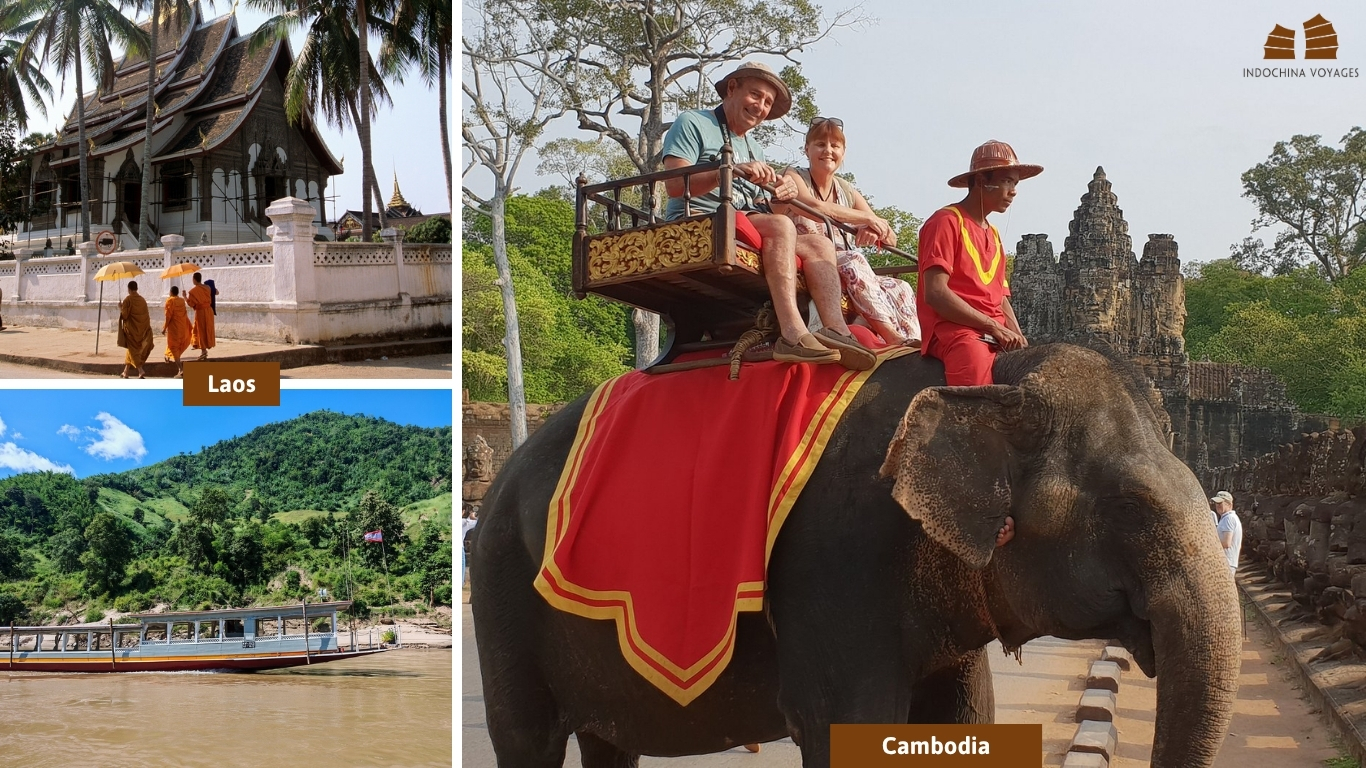
Laos rewards travelers who are happy to let a place set the pace. Luang Prabang, a UNESCO World Heritage town, is the natural base: temples line the old peninsula, a morning market runs before the heat builds, and the Mekong and Nam Khan rivers frame the evenings.
Beyond the town, the appeal is largely outdoors. Kuang Si Falls, with its tiered turquoise pools, is the best known day trip. Around Vang Vieng, limestone karst rises above the Nam Song River, which suits kayaking, cycling and guided walks. Mekong river journeys and village visits add context that a road trip rarely provides. The pace is generous: most itineraries work best with two or three nights in each stop rather than a new town every day. If you prefer somewhere less visited, read about three Laos destinations to see before the crowds arrive.
Choose Cambodia if you want iconic history and more variety
Cambodia offers a wider range within a compact area. Angkor Archaeological Park, near Siem Reap, holds Angkor Wat, the faces of Bayon and the tree-wrapped ruins of Ta Prohm. Phnom Penh adds the Royal Palace, the National Museum and an essential, sobering account of the Khmer Rouge years.
The country also pairs culture with coast. Kampot and Kep offer a quieter southern base with river and pepper-farm excursions, while Koh Rong and Koh Rong Samloem provide island time. Cities, markets, restaurants and nightlife make it easy to balance sightseeing with downtime.
Which is better for couples, families or older travelers?
Age matters less than itinerary design. What decides comfort is how much walking, how many hours on the road, and how much rest the schedule allows.
- Cambodia: Angkor involves long days on foot, stairs, uneven stone and midday heat. Splitting visits into a sunrise session and a late-afternoon return, with a break between, makes a large difference. Private transfers between cities are straightforward.
- Laos: Rural excursions can involve winding roads, unpaved sections and boat access. The railway shortens the main northern legs considerably, and hotels in Luang Prabang are generally well suited to slower, shorter days.
Whichever country you choose, private vehicles, a licensed guide and one unscheduled day for every three or four days of sightseeing are what keep a trip comfortable. Families can also read our guide to Cambodia with kids.
>>>> Curious how these two styles look day by day? See sample itineraries here.
Culture and history: living traditions or ancient temples?
Both countries are shaped by Buddhism, but the experience on the ground differs. In Laos, religion is something you encounter as it is practiced. In Cambodia, much of the story is told through monumental architecture and recent history.
Laos: Buddhist traditions and heritage towns
In Luang Prabang, the morning alms-giving ceremony is the clearest example of living tradition. Monks walk the streets at dawn and receive offerings of sticky rice. It is a religious practice, not a performance, so the respectful approach is to observe quietly from a distance, dress modestly and avoid flash photography. Wat Xieng Thong and Wat Mai show the classical Lao style of tiered roofs and gilded detail.
Vientiane is the quieter capital. Pha That Luang, the national symbol, and Wat Si Saket, known for its thousands of small Buddha images, give a compact introduction to the country’s Buddhist heritage. Markets and textile workshops in both cities reflect craft traditions that are still in daily use.
Laos also has heritage that complicates the idea that temples mean Cambodia. Wat Phou, a UNESCO-listed Khmer-era sanctuary near Champasak in the south, predates Angkor Wat. The Plain of Jars in Xieng Khouang Province is another UNESCO site, though it also carries the legacy of unexploded ordnance, so visits should stay on marked paths.

Cambodia: the Khmer Empire and modern history
Angkor is best understood as three distinct experiences rather than one. Angkor Wat is the symmetrical masterpiece of the early twelfth century, with long bas-relief galleries. Bayon, in Angkor Thom, is defined by its multiple carved faces. Ta Prohm is the one where roots and stone have grown together, left deliberately in a partly overtaken state. Allow at least two days if you want to see them without rushing.
Phnom Penh deepens the picture. The Royal Palace and Silver Pagoda represent living royal and Buddhist tradition, and the National Museum holds Khmer sculpture. Tuol Sleng Genocide Museum and Choeung Ek memorialize the Khmer Rouge period. Both are best visited with time set aside afterward, with respectful dress and no photography where it is prohibited.
On Tonle Sap Lake, floating and stilted communities depend on a seasonal flood cycle. Choosing a locally run operator keeps more of the benefit in the community.

A licensed guide adds a great deal at Angkor and in Phnom Penh. Browse our Indochina tours for guided routes through Cambodia.
Nature and outdoor activities in Laos vs Cambodia
The two countries offer different kinds of outdoor time. Laos is mainly about inland landscape and river; Cambodia combines wetlands, highlands and sea.
Laos: waterfalls, karst mountains and the Mekong
- Kuang Si Falls, near Luang Prabang: tiered limestone pools, with a short forest walk above the main cascade.
- Vang Vieng: karst scenery along the Nam Song, with kayaking, cycling and cave visits.
- Bolaven Plateau: cooler highland country in the south with coffee farms and waterfalls such as Tad Fane.
- The Mekong: slow boat and cruise options, including the Huay Xai to Luang Prabang journey, which suits travelers who prefer a river to a road.

Cambodia: islands, lakes and wildlife
- Koh Rong and Koh Rong Samloem: beaches and snorkeling, best during the drier months when seas are calmer.
- Tonle Sap: a changing wetland with flooded forest and birdlife, most extensive after the rains.
- Kampot and Kep: a slower coast with river, pepper-plantation and crab-market excursions.
- Highlands and parks: the Cardamom Mountains and Bokor National Park offer guided trekking and wildlife for those who want to go beyond the beaches.

Which country is better for active travel?
For mountain walking, kayaking and river activities, Laos has the stronger case. For coastal days, wetlands and selected nature reserves, Cambodia does. Difficulty and access depend on season and location, so confirm conditions with a licensed operator before booking any trek or boat trip, and avoid frontier areas covered by government travel advisories.
Food and nightlife: what are the evenings like?
Lao vs Cambodian food
Lao cooking is herb-forward and built around sticky rice, eaten by hand. Signature dishes include laap (a minced-meat salad with lime, herbs and toasted rice), tam mak hoong (green papaya salad), mok pa (steamed fish in banana leaf) and jeow, the chili-based dips served alongside. Flavors can run bitter, sour and very spicy.
Cambodian food leans toward a sweet-sour balance with aromatic pastes known as kroeung. Look for fish amok (a steamed coconut curry), lok lak (stir-fried beef with a lime-and-pepper dip) and nom banh chok (rice noodles with fish gravy and fresh herbs). Chili is often served on the side, so the heat is yours to adjust.
Both cuisines rely on fermented fish as a base seasoning, and both are best explored in local markets. Familiar international options are easy to find in Luang Prabang, Vientiane, Siem Reap and Phnom Penh. For a Lao starting point, see our guide to Lao street food.

Night markets, riverside dining and nightlife
In Laos, evenings center on the Luang Prabang night market, riverside restaurants in Luang Prabang and Vientiane, and early nights. Venues generally close earlier than in Cambodia.
Cambodia has more conventional nightlife. In Siem Reap, Pub Street and nearby night markets form the main hub. Phnom Penh’s riverfront offers restaurants, bars and rooftop venues. In short, Cambodia suits travelers who want a lively evening, and Laos suits those who prefer a quiet one.

>>>> Want local markets and meals built into your route? Read more about how we plan it.
Laos vs Cambodia: which is cheaper for travelers?
Both countries are affordable by regional standards, and the gap is smaller than most people expect. A fair comparison looks at equivalent services, such as a room, a meal and a transfer, rather than a single attraction. Comparing a waterfall fee in Laos with an Angkor ticket in Cambodia says little about overall cost because the experiences are not alike.
| Item (unit) | Laos | Cambodia |
|---|---|---|
| Mid-range hotel (per room, per night) | about US$25–60 | about US$20–50 |
| Local meal (per person) | about US$2–5 | about US$3–8 |
| Sit-down restaurant meal (per person) | about US$4–10 | about US$5–15 |
| Long-distance bus (per person) | about US$10–25 | about US$5–15 |
| Train or domestic flight (per person, per journey) | Train Vientiane–Luang Prabang from roughly US$13 at the counter; flights cost more | Domestic flights vary by route |
| Short tuk-tuk ride (per ride) | about US$1–3 | about US$1–3 |
These are indicative ranges for 2026 and change with season and location.
Attraction fees are separate. Angkor passes cost US$37 for one day, US$62 for three days (valid within seven days) and US$72 for seven days (valid within a month); children under 12 are free. Entry fees at Laos sites such as Kuang Si are far lower, but they are a small part of a trip budget either way.
What moves the total most:
- Private transfers and guides: these raise costs in both countries, and more so in Laos, where distances are longer.
- Hotel category: Luang Prabang and Siem Reap carry a premium over smaller towns.
- Season: December and January are the busiest months, with higher room rates.
In practice, Cambodia is often a little cheaper day to day outside Angkor, while Laos can cost more per kilometer because of rural transport. Which is cheaper for you depends on your route and travel style, especially once the cost of moving between destinations is included.
Getting around Laos vs Cambodia
Getting around Laos
The Laos–China Railway has changed travel in the north. Trains link Vientiane, Vang Vieng and Luang Prabang: Vientiane to Vang Vieng takes about an hour, and Vientiane to Luang Prabang under two. The stations sit well outside the town centers, so factor in a transfer on each end. See our guides to the train from Vientiane to Luang Prabang and to getting from Vang Vieng to Luang Prabang.
For places away from the line, including the south and the east, buses, private vehicles and domestic flights are the options. Mountain roads and rural transfers often take longer than the distance suggests.
Travelers entering from northern Thailand can take the scenic Mekong cruise between Huay Xai, on the Lao side of the border, and Luang Prabang, as an alternative to buses or speedboats. See our guide to cruising from Huay Xai to Luang Prabang, explore a Mekong cruise, or read how to get from Chiang Rai to Luang Prabang.

Getting around Cambodia
Road transfers connect Phnom Penh, Siem Reap and the southern coast, and buses and private cars are the usual way to cover them. Domestic flights save time on longer legs but add airport transfers, which matter more now that both main airports are new and sit outside their cities: Siem Reap-Angkor International Airport opened in 2023, and Techo International Airport, serving Phnom Penh, began operating in September 2025 and replaced the old airport. Reaching the islands involves a road transfer to the coast and then a boat. Journey times vary by route and season, so allow margin.
Entering from neighboring countries
One important change affects overland planning. Thailand’s land crossings into Cambodia have been closed since June 2025, and flights are the dependable way to enter from Thailand. Travelers coming from Vietnam have other options; see how to get from Saigon to Siem Reap.
>>>> Adding Vietnam to the route? Explore our Vietnam travel packages.
Can you travel from Laos to Cambodia easily?
Yes, but flying is the practical route for most itineraries. Direct flights between Siem Reap and Luang Prabang operate on a limited, seasonal schedule, and a direct Phnom Penh to Vientiane service launched in January 2026 with two flights a week. Otherwise, connections run through hubs such as Bangkok or Hanoi.
The one land crossing is in the far south, between Veun Kham in Laos and Dong Kralor in Cambodia, which suits travelers combining the Si Phan Don islands with northeastern Cambodia but is not a sensible link between Luang Prabang and Siem Reap. Compare total journey time, convenience and cost, and check flight schedules, border arrangements and visa eligibility before you book anything non-refundable.
Prefer not to coordinate flights, trains and transfers yourself? Indochina travel packages can be built around your dates.
Best time to visit Laos vs Cambodia
The two countries share a tropical monsoon pattern, but the details differ by region. National averages are a starting point; the destinations on your route matter more.
Dry season: generally easier for sightseeing
The drier months run from roughly November to April. November to February is the most comfortable stretch, with lower humidity and clearer skies, which suits temple visits, outdoor activities and itineraries with several stops. Temperatures climb steadily through March and April, and Angkor in the late dry season can be very hot by midday. This is also when the islands are at their best and the seas are calmest. In northern Laos, December and January mornings and evenings can feel cool, so bring a light layer.
Wet season: green landscapes and seasonal trade-offs
From about May to October the countryside turns green, waterfalls are at full volume and there are fewer visitors. The trade-offs are heavy afternoon showers, muddy trails, high river levels that can change boat schedules, and occasional transport disruption. Tonle Sap is at its fullest in this season, and some travelers find the lake more interesting then. Seas around the Cambodian islands can be rougher. Prices are often lower. See our guides to Cambodia in August, Laos in August and Laos in October.
When is the best time to visit both countries on one trip?
For a combined itinerary, November to February is the most reliable window. Plan around the specific places you will visit rather than the national picture. Northern Laos is cooler than Cambodia in winter, southern Cambodia has its own rainfall pattern, and in the late dry season (roughly March and April) agricultural burning can cause smoke haze in parts of northern Laos, reducing views and air quality. For month-by-month detail, see the best time to visit Cambodia and Laos weather by month.
Adding Vietnam? Its seasons differ by region, so check timing before you plan a trip to Vietnam alongside Laos and Cambodia.

>>>> Traveling in a specific month? Read more about how Laos routes change through the year.
Visa requirements, safety and practical travel tips
Visa requirements for Laos and Cambodia
Entry rules depend on your passport nationality, the purpose of your visit and your point of entry, and neither country offers a combined visa. Both offer a tourist visa on arrival at major international airports, and both offer an online option: apply through the official Lao e-visa site or the Cambodia e-Visa site. Cambodia’s tourist visa on arrival costs US$30, and Lao fees vary by nationality.
Two points deserve attention before you book:
- Entry points: the Lao e-visa is accepted only at designated entry points, so check that your chosen airport or border crossing is on the list, particularly for land routes.
- Digital arrival forms: Cambodia requires a free online e-Arrival card, submitted within seven days before arrival. Laos has introduced the Lao Digital Immigration Form (LDIF), a free online form that produces a QR code, submitted shortly before entering or leaving the country. Both are separate from the visa.
>>>> Unsure which entry rules apply to your passport? Speak with our team.
Safety and health considerations
Both countries are generally safe for visitors, and violent crime against tourists is uncommon. The practical risks are ordinary ones:
- Theft and transport: bag snatching occurs in busy parts of Phnom Penh, and unlicensed taxis at airports can overcharge. Use a ride-hailing app such as Grab or agree the fare before getting in. Road conditions in rural Laos can be poor.
- Outdoor activities: use reputable operators for river trips, kayaking, caving and treks, and ask about safety equipment and local water levels.
- Unexploded ordnance in Laos: parts of the country, including Xieng Khouang Province around the Plain of Jars, still contain unexploded bombs from past conflict. Stay on marked paths and use licensed local guides.
- Border areas: follow your government’s advice and avoid areas near the Thailand–Cambodia frontier.
- Insurance: take travel insurance that includes medical evacuation, especially if you plan adventure activities.
>>>> Licensed guides and private vehicles can be arranged through Indochina Voyages.
Language, connectivity and money
English is widely used in the tourist areas of both countries and is generally more common in Siem Reap and Phnom Penh than in smaller Lao towns. Download offline maps and the Khmer and Lao language packs for a translation app; camera translation helps with menus and signs.
Laos uses the Lao kip, and card acceptance thins out quickly outside the main towns. Cambodia uses the riel, but US dollars are widely used in tourism, with small change often given in riel. Check current payment practices and carry enough cash for rural areas.

>>>> Payment and booking steps are explained on this page.
How many days do you need in Laos vs Cambodia?
Treat these as planning ranges, not fixed rules. Arrival and departure flights reduce the number of full sightseeing days, so a seven-day trip often contains five or six real days.
If you have 5–7 days
- Cambodia: Siem Reap and Angkor are the core. Add Phnom Penh if the schedule allows.
- Laos: concentrate on Luang Prabang and its surroundings rather than trying to cross the country.
>>>> For a fuller version, see our 7 days in Laos itinerary.
If you have 8–10 days
- Cambodia: combine Siem Reap with Phnom Penh or a coastal stop such as Kampot, depending on whether history or sea air matters more.
- Laos: link Luang Prabang, Vang Vieng and Vientiane, allowing time for the train legs between them.
If you have 12–14 days or more
A longer trip allows additional destinations, rest days and less rushed transfers. It is also when visiting both countries becomes realistic, provided the international connection fits your dates. Southern Laos, Kampot or the islands can be added without turning the schedule into a relay.
>>>> Want a ready-made length? Browse our Indochina tours by number of days.
Can you visit Laos and Cambodia on the same trip?
When combining both countries makes sense
The two countries contrast in useful ways. Cambodia contributes archaeological scale, a capital with a hard and important history, and a coastline. Laos contributes river landscapes, mountain scenery and a slower daily rhythm. After several busy days around Angkor, Luang Prabang is a good counterweight. A single flight links them, so the transition costs hours, not a day.
Suggested Laos and Cambodia route
This 12-day route runs from Phnom Penh to Vientiane, so you never double back, and it uses the railway for the Laos leg.
| Days | Stop | Highlights | Getting there |
|---|---|---|---|
| 1–2 | Phnom Penh | Royal Palace and National Museum; Tuol Sleng and Choeung Ek if you choose to visit | Arrive at Techo International Airport |
| 3–5 | Siem Reap | Angkor Wat at sunrise, Bayon and Ta Prohm, with a quiet afternoon between temple visits | Road transfer or short flight from Phnom Penh |
| 6 | Siem Reap to Luang Prabang | Travel day, with an evening walk through the night market | Direct flight where available, otherwise connect via Bangkok or Hanoi |
| 7–9 | Luang Prabang | Morning alms-giving, Wat Xieng Thong and a full day at Kuang Si Falls | Walkable old town; a road transfer to Kuang Si |
| 10 | Vang Vieng | Karst scenery, with kayaking or cycling along the Nam Song | Train from Luang Prabang, under an hour |
| 11–12 | Vientiane | Pha That Luang, Wat Si Saket and the Mekong riverfront, then departure | Train from Vang Vieng, about an hour |
Treat this as a template. Flight availability decides the sequence, and adding a day or two is better than dropping the rest days.
>>>> For day-by-day detail, see our guide to doing Laos and Cambodia in one week. To add Vietnam, see our Vietnam tours or a Halong Bay cruise.
At Indochina Voyages, our specialists shape custom Indochina packages around your interests, comfort preferences and travel dates. Prefer email? Write to info@indochinavoyages.com.
Frequently asked questions
The strongest Laos and Cambodia trips are matched to the traveler’s pace, not to a checklist of sights. Give each stop enough time, leave room for the unplanned afternoon, and whichever country you begin with, the other is only a short flight away when you are ready for it. Common booking and planning questions are answered on this page.