
One day in Luang Prabang is enough to fall for the former royal capital and see why it holds UNESCO World Heritage status, as long as you build your day around a few thoughtful choices rather than a checklist. The old town sits on a narrow peninsula between the Mekong and the Nam Khan, so temples, the former palace, markets and riverside cafés are all within an easy walk. The two best-known excursions, Kuang Si Waterfall and the Pak Ou Caves, each need a separate half day, so we’ll help you decide whether to include one.
In this guide, we share a practical route for a full day, from the dawn alms-giving to the evening Night Market. We also show which stops you can swap and flag the closing days that most often catch visitors by surprise. Many people spend just one day here as a stopover, arriving by rail or air, so we cover your arrival options too.
Choose What Matters to You Before You Plan the Day
The historic core is compact, so timing matters more than distance. Three anchors shape almost every short visit: dawn for the alms-giving, daytime opening hours for the palace, museums and temples, and late afternoon into evening for Mount Phousi and the Night Market.
It helps to decide which kind of day you’d enjoy most:
- A culture-led day centred on temples, the Royal Palace Museum and the ethnology centre.
- A food-and-craft day built around the morning market, a cooking class and a weaving studio.
- A nature-led day that pairs Kuang Si or Pak Ou with a shorter old-town loop.
Closing days can reshape your plan, so they’re worth checking before you go. The Royal Palace Museum is closed on Tuesdays and, according to the Indochina Voyages day-tour notes, on the last Thursday of each month. The Traditional Arts and Ethnology Centre is closed on Mondays. If your day falls on one of these, you can simply reverse the order of the route or swap in a second temple. Season matters as well: heat and rain change how comfortable the steps and paths are, and our Laos weather by month guide helps with timing. Travellers who want the logistics handled can also review our Indochina tours.
A Sample Route for One Day in Luang Prabang
From the dawn alms-giving to the Night Market: here is how one day in Luang Prabang can unfold
Think of the route below as a template you can make your own, because every row has a substitute. We give clock times only for the alms-giving, since the official windows change with the season.
| Time block | Core stop | Swap or drop | Detail section |
|---|---|---|---|
| Dawn (about 5:30–6:30 March to October; 6:00–7:00 November to February) | Sai Bat, the morning alms-giving | Sleep in and visit the morning market instead | Alms-giving |
| Morning | Wat Xieng Thong, then the Royal Palace Museum | Replace the palace with a second temple | Temples |
| Midday | Lao lunch at a local eatery or a market meal | Cooking class (replaces the afternoon) | Cuisine |
| Afternoon | Old-town walk and the Traditional Arts and Ethnology Centre | Half-day excursion to Kuang Si or Pak Ou | Old town, cultural stop |
| Late afternoon | Mount Phousi | Riverside café on the Nam Khan | Phousi |
| Evening | Night Market from about 5 pm | Quiet sit-down dinner | Night Market |
We chose this order on purpose. Published schedules show the Royal Palace Museum pausing around midday, so it fits best in your morning. The main stairway up Mount Phousi starts opposite the palace, close to the Night Market, so your late afternoon and evening flow together with no backtracking.
Explore the Private Day Tour: Guide, Lunch and Entry Fees Included
Experience the Morning Alms-Giving Ceremony Respectfully
Sai Bat is a long-cherished Lao Buddhist practice. At first light, residents offer food, usually sticky rice, to monks and novices as they walk through the streets. It is above all an act of devotion, so we invite you to take part as a thoughtful guest.
According to the official Luang Prabang tourism website, the procession begins around 5:30 to 6:30 am from March to October and 6:00 to 7:00 am from November to February The main procession points it names are in front of Wat Xieng Thong, near Luang Prabang Primary School and by the National Museum.
Taking part is entirely your choice. You are very welcome to observe quietly, and you only need to make an offering if it feels meaningful to you. If you’d like to give, you can buy sticky rice at the local morning market or ask your hotel or guide to arrange it for you.
A few points of etiquette help everyone enjoy the moment:
- Please dress modestly, with shoulders, chest and legs covered.
- Keep a respectful distance, and please don’t step into the route or block the procession.
- Photograph without flash, or put your camera away and simply take it in.
- Please avoid touching the monks or their alms bowls.
Large tour buses are not permitted inside the heritage zone, so guided visitors usually arrive on foot. Our alms-giving etiquette guide explains the ceremony in more depth, and if you’d like to attend with a guide, our team will gladly arrange it.
Our tip: arrive about 15 minutes before the window opens and settle in away from the main procession points, where visitors tend to gather. If you plan to give, buy your sticky rice at the market that same morning.
Explore Luang Prabang’s Historic Temples and Royal Heritage
The old town holds a rich concentration of temples, and trying to see them all would use up your whole day. We suggest choosing by interest: architecture, royal history or quiet religious sites.
Wat Xieng Thong: Roofline, Mosaics and Royal Associations
Founded around 1560 under King Setthathirath, Wat Xieng Thong stands at the tip of the peninsula, close to where the Mekong and the Nam Khan meet. Its sweeping low roofs, glass mosaics and the tree-of-life design on the ordination hall make it our top choice if you love religious art and Lao architecture. An entry fee applies, and the temple opens in the morning, which suits our route well.

Royal Palace Museum: A Glimpse into Laos’s Royal Past
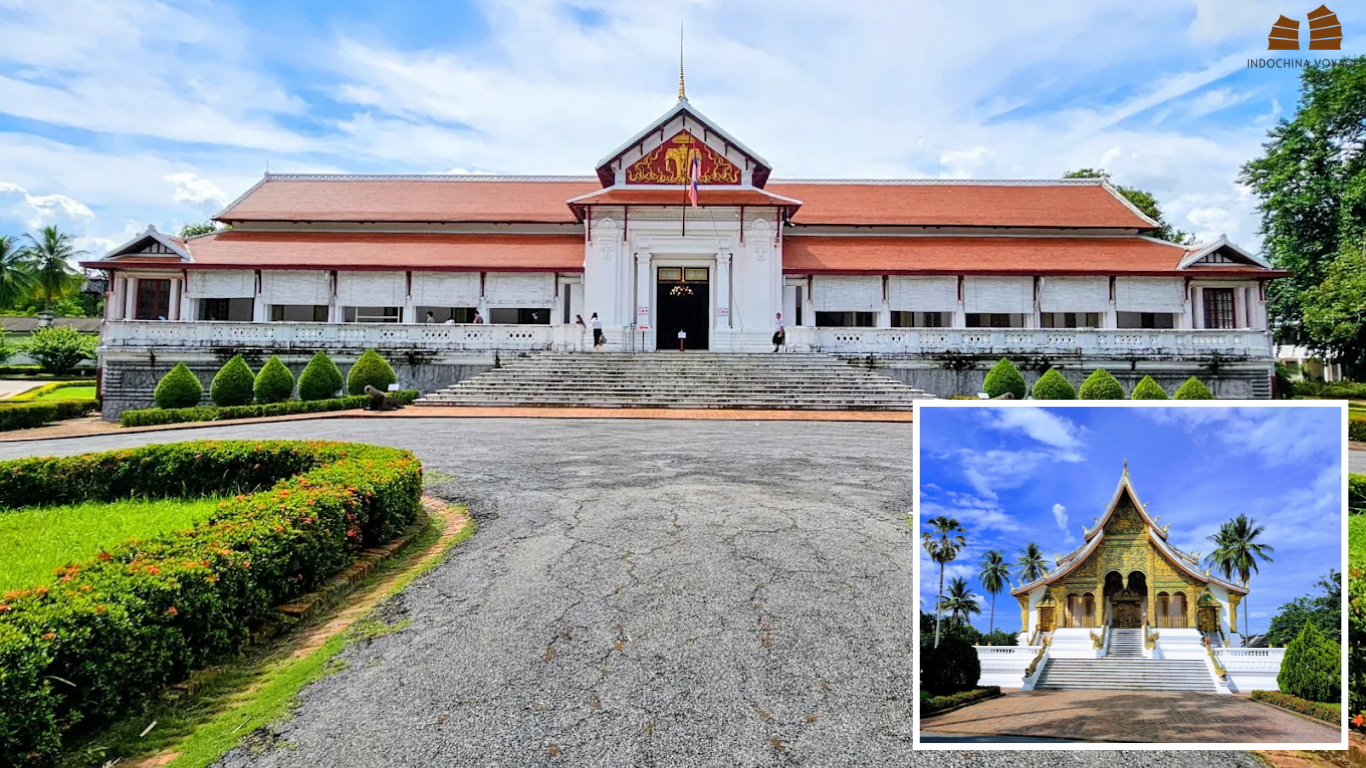
Begun in the early twentieth century as the residence of the Lao king, the palace combines Lao design with French Beaux-Arts influence. Today it is a museum of royal regalia and artworks, and its grounds include Haw Pha Bang, the chapel associated with the Pha Bang Buddha image.
A few practical details will help you plan. The museum is closed on Tuesdays and on the last Thursday of each month, photography is not permitted inside, bags and cameras are kept in lockers, and modest dress is expected. We recommend visiting in the morning.
Wat Visoun, Wat Aham and Wat Mahathat: Alternatives for Temple Enthusiasts
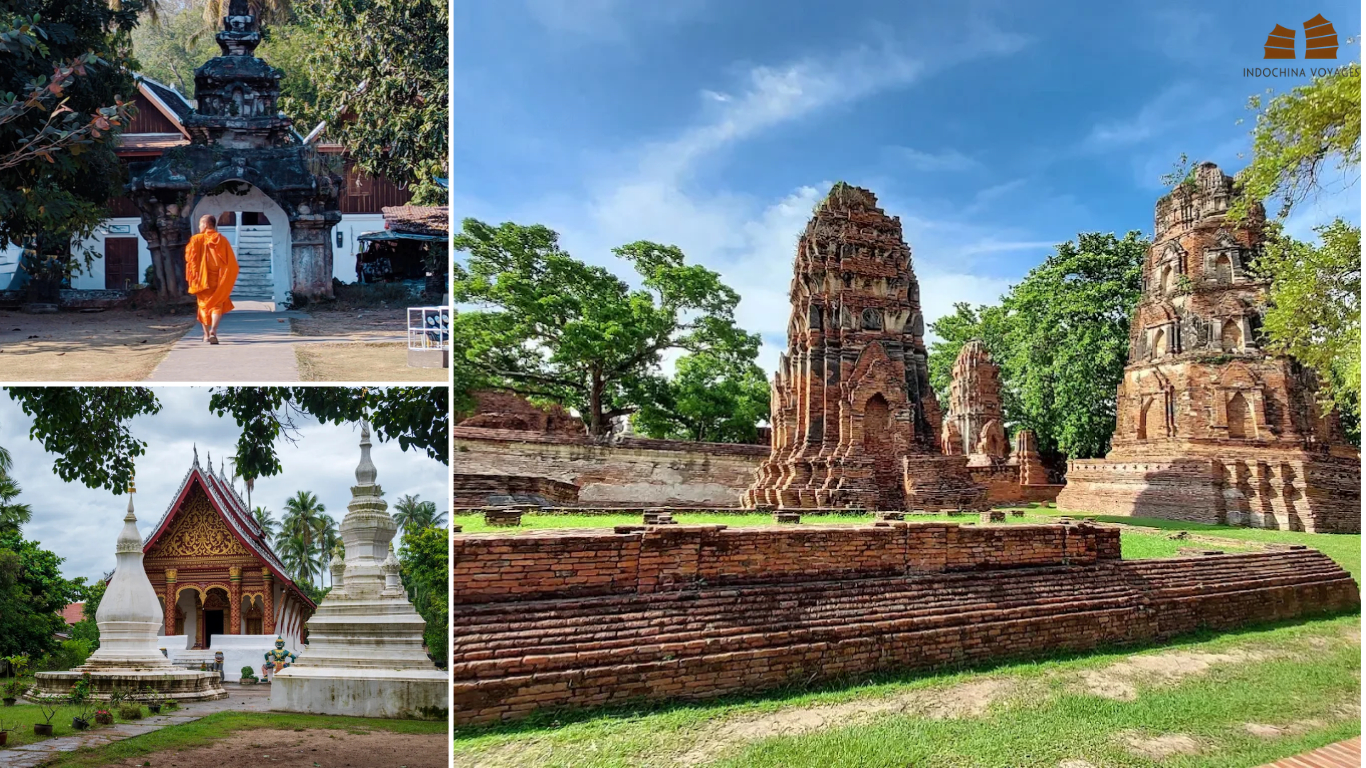
Dating to 1512, Wat Visoun is cited as the oldest temple still in continuous use. Beside it stands Wat Aham, which has a long association with guardian-spirit worship and gives the pair a different character from the royal temples. Known for its stupa, Wat Mahathat adds a further royal connection.
We’d suggest choosing one pairing, such as Visoun and Aham, rather than treating all four sites as essential. The time you save is better spent enjoying the town itself.
💡Our tip: start at Wat Xieng Thong when it opens, then continue on foot to the Royal Palace Museum so you arrive well before its midday break. Both lie along the same stretch of the old town, so you can take your time.
Discover Lao Cuisine in Luang Prabang
You can enjoy Lao food as a market snack, a sit-down meal or a structured class, and each option takes a different amount of your day.
Lao Dishes Worth Ordering
- Khao soi: the northern Lao noodle soup with minced pork, tomato and fermented soybean; every kitchen makes it a little differently.
- Laap: seasoned minced meat or fish with fresh herbs and toasted rice.
- Sticky rice (khao niao): the staple that accompanies most savoury dishes, traditionally eaten by hand.
- Khai paen: dried Mekong river weed, crisped and served with a dipping sauce.
- Tam mak hoong: the Lao version of green papaya salad, often very spicy.
If you have time, two local specialities are well worth seeking out: sai oua, the Luang Prabang pork sausage seasoned with lemongrass and galangal, and or lam, a stew built around wood-ear mushroom and the sakaan vine.

Three Ways to Eat
The morning market sets up early and winds down by mid-morning, so it’s the natural place for a quick breakfast or snacks. A local eatery suits a relaxed lunch of everyday dishes, and the cafés along the river serve French-era baguettes and coffee, a delicious legacy of the colonial period.
A cooking class gives the deepest introduction to ingredients, though it carries a real time cost. Tamarind, for example, runs a restaurant in town and a cooking school about 20 minutes outside it; the day class includes a market visit, while the evening class runs for roughly four hours. In a single day, a class replaces either the afternoon or the Night Market, and booking ahead is required. Travellers who want a class built into the trip can ask about custom Indochina packages.
💡Our tip: on a single day, a market breakfast and a local lunch let you taste more Lao dishes in less time than a class would. We’d save the cooking class for a longer stay, when you can enjoy it without rushing.
Wander Through the Old Town and Along the Rivers
If you’d rather not add a third or fourth temple, the town itself is the attraction. The peninsula blends timber and masonry Lao houses with French colonial shopfronts, a combination that earned UNESCO inscription in 1995.
The side lanes off Sisavangvong Road reward unhurried walking, with independent shops, small cafés and the banks of both rivers just minutes apart. We’d love you to leave at least one unscheduled hour, so your day isn’t filled with ticketed sites.
A guided walk adds architectural and historical context that is hard to gather alone, while independent exploration offers flexibility; for guided options, read more on this page. Our guide to less-visited corners of Luang Prabang suggests places away from the main street.
Add a Cultural Stop Beyond Sightseeing
A short cultural stop gives your day more depth than another landmark would.
- Traditional Arts and Ethnology Centre
This non-profit museum on Kingkitsarath Road, founded in 2006, is open Tuesday to Sunday from 9 am to 6 pm and closed on Monday. Its displays of textiles, clothing, jewellery and ritual objects represent roughly thirty ethnic groups of Laos, and they offer wonderful context if you’re planning a village visit.
- English Conversation Hours at Big Brother Mouse
Big Brother Mouse, a Lao-run literacy organisation based in central Luang Prabang, invites visitors to join English conversation practice with young adults. Sessions are listed daily at 9 am and no reservation is needed, though schedules change and are posted at its office. It’s a genuine exchange rather than a spectacle, and it’s perfect if you like to take part rather than simply watch.
- Craft Studios and Weaving Villages
Silk and cotton weaving studios, such as the Living Crafts Centre run by Ock Pop Tock, show dyeing and loom work at close range. Choose a workshop that pays its artisans fairly and explains how each piece is made. Weaving visits can also be combined with other stops in our Indochina tours.
Is Mount Phousi Worth the Climb?
We think so, if the stairs suit you. Mount Phousi rises about 100 metres above the old town and is crowned by Wat Chom Si, a stupa-topped shrine. The main stairway has 328 steps and begins opposite the Royal Palace Museum; the alternative route from Thanon Phousi has about 355. Allow 30 to 60 minutes, including time at the summit.
The steps are uneven and there is no step-free route, so the climb suits some travellers better than others. Sunset draws crowds, and haze or cloud can flatten the view, so arriving early is sensible. Sunrise is quieter, with access from about 5:30 am. The summit shrine is an active place of worship, so please cover your shoulders and knees.
If you’d prefer to avoid stairs or crowds, a riverside café on the Nam Khan at sunset is a calm and lovely alternative.
💡Our tip: climb by the main stairway opposite the Royal Palace Museum and reach the top before the sunset crowd. Carry water and small kip notes for the entrance ticket collected along the way. The descent leads you straight toward the Night Market.
Browse the Night Market and Nearby Food Stalls
- What the Market Sells
The Night Market runs daily from about 5 pm to 10 pm along Sisavangvong Road, from the tourism office toward the Royal Palace Museum, and the street closes to vehicles while it operates. The official tourism website counts roughly 250 handicraft vendors and describes the range as the most extensive in the country, with textiles, handicrafts and souvenirs from local ethnic groups.
Some stalls sell imported goods, so it’s worth asking who made an item and where. Buying directly from the makers supports local artisans.
- Eating at the Market or Nearby
Stalls and side lanes serve sticky rice, grilled chicken and fish, papaya salad and steamed fish in banana leaf. If you’d like a quieter evening, a sit-down restaurant nearby is a lovely option. The market is a happy way to end your day, not a requirement.

Kuang Si Waterfall or Pak Ou Caves: Which Excursion Fits You?
Both excursions take roughly half a day, and neither fits into an old-town day without cutting something, so we’d suggest choosing the one that appeals to you most.
| Kuang Si Waterfall | Pak Ou Caves | |
|---|---|---|
| Distance | About 29–30 km south | About 25 km upstream on the Mekong |
| Journey | About 45 minutes by road | Roughly 1.5 hours each way by boat, or by road to Pak Ou village plus a short crossing |
| Main appeal | Tiered turquoise pools and forest paths | Caves holding thousands of Buddha images; river scenery |
| Suits | Nature, photography, swimming where permitted | Religious heritage and river travel |
| Trade-off | Takes a half day from the old town | Longest travel time; shrinks the old-town day the most |
If you choose Kuang Si, you can pair a morning there with a late-afternoon climb up Phousi and an evening at the Night Market, though the alms-giving and the palace would drop out. If you’d love to see both excursions, a longer stay lets you enjoy each without rushing. seven-day Laos itinerary covers each, and longer itineraries in our Laos tours include both.
And if the Mekong has captured your imagination, you can discover our Mekong cruises, which run downstream through Cambodia and Vietnam.
Arriving for One Day: Rail, Flight and Road Options
One-day stays often sit between Vientiane, Vang Vieng, Hanoi and Chiang Rai. The Laos–China Railway has shortened the journeys from Vientiane and Vang Vieng considerably, and we’ve written a guide for each route:
- Train from Vientiane to Luang Prabang
- Vang Vieng to Luang Prabang
- Hanoi to Luang Prabang
- Chiang Rai to Luang Prabang
If you can arrive the evening before, the alms-giving and the morning temples become easy to fit in. If you arrive the same morning, the dawn block simply drops out of the route, and you’ll still have a lovely day. Continuing from Hanoi? You can pair your stay with our Vietnam tours.
Practical Tips for One Day in Luang Prabang
Luang Prabang often forms one stop in a wider journey, which is where our Indochina travel packages connect it with Vietnam and neighbouring countries. In the meantime, these small points will keep your single day running smoothly:
- Getting around: the historic core is walkable, so save tuk-tuks and private cars for excursions and weaving villages. It’s worth agreeing the tuk-tuk price before you set off.
- Dress: cover your shoulders and knees at temples, the palace and the alms-giving; a light scarf or sarong is handy.
- Closing days: the Royal Palace Museum on Tuesdays and the last Thursday of each month; the Traditional Arts and Ethnology Centre on Mondays.
- Heat, rain and surfaces: Phousi’s stairs and wet-season paths call for sturdy footwear.
- Money: carry Lao kip in small notes for entry fees, market stalls and transport.
- Pace: we suggest four anchor stops with a little breathing room between them, and if you arrive late, don’t worry about the dawn block.
Not sure how Luang Prabang fits into your wider trip? Tell us your dates and interests, and one of our local specialists will shape a plan around you.
Tailor Your Luang Prabang Day With a Local Specialist
Is One Day Enough in Luang Prabang?
One day gives you a lovely first impression of the town, but it won’t stretch to the old town, an excursion and unhurried meals all together. It suits a tight wider itinerary or a stopover beautifully, and for many travellers it’s just enough to know they’ll want to come back. With two or three days, you can add Kuang Si or Pak Ou and slow down over food and craft stops. To compare longer plans, you can browse our sample itineraries here.
If you’d like transport, closing days and sequencing handled for you, a private guided day is a relaxing choice, and the Indochina Voyages private Luang Prabang day tour follows a route close to the one above. If you prefer to explore independently, you’re very welcome to follow this guide at your own pace. The right length of stay depends on what you want from the town, not on a single ideal schedule.
Browse Indochina Travel Packages That Include Luang Prabang
Frequently Asked Questions
How many days do you need in Luang Prabang?
We suggest two to three days, which allow the old town at an easier pace plus one excursion; one day suits a stopover or a tight route.
What time is the alms-giving ceremony in Luang Prabang?
About 5:30 to 6:30 am from March to October and 6:00 to 7:00 am from November to February, according to the official tourism website.
Can you visit Kuang Si Waterfall and the old town in one day?
Yes, with some trade-offs: a half-day excursion leaves your late afternoon and evening for one temple, Mount Phousi and the Night Market.
Is Luang Prabang walkable?
Very. The historic core is compact and easy on foot; excursions, weaving villages and airport transfers need a vehicle.
What should you wear to temples and the alms-giving ceremony?
Please cover your shoulders, chest and legs, and bring a scarf for sites that ask for extra coverage.
Which day of the week is best for one day in Luang Prabang?
If the Royal Palace Museum matters to you, we’d avoid Tuesdays and the last Thursday of the month; if the ethnology centre is a priority, avoid Mondays.
Planning a Luang Prabang stay and want a hand? We’d love to hear from you. Send your questions, dates or ideas to info@indochinavoyages.com, and one of our specialists will reply with a personal suggestion.
IV Travel Specialist