
Vietnam stretches more than 1,600 kilometres from top to bottom, and it’s tempting to squeeze every highlight into a single week. Try it, and you may spend more time at airports than in the places you came to see.
The good news is that a week can work well if you choose your approach carefully. You can stay in one region for a deeper experience, combine a few nearby destinations, or cover the whole country at a faster pace. Below are five tried-and-tested 7-day routes, plus an honest look at what a north-to-south trip really involves.
If you’d like to see what’s possible before reading on, you’re welcome to browse our Vietnam tours for inspiration.
Is 7 Days Enough in Vietnam?
Yes, if you focus on one region. Seven days gives you time to enjoy a few destinations properly. A north-to-south trip is possible, but it means flights and quick stops.
How much does it cost? Expect roughly $300–$550 per person for an independent budget week, $750–$1,000 for a private mid-range tour, and $1,100–$2,100 for a luxury trip, all excluding international flights.
| Route | Region | Best for | Pace |
|---|---|---|---|
| Hanoi, Ninh Binh & Halong Bay | North | First-timers, families | Relaxed |
| Hanoi, Halong Bay & Sapa | North | Mountain scenery | Moderate |
| Ha Giang, Cao Bang & Ba Be | Northeast | Adventurers | Demanding |
| Hue, Hoi An & Da Nang | Central | History, food | Relaxed |
| Ho Chi Minh City & Mekong Delta | South | Culture, river life |
Private tour, two travelers sharing, Superior to Deluxe hotels, excluding international flights. Full breakdown in the cost section below.
>>> Related readings:
- Vietnam Itinerary in 5 Days: Suggested Tour By Region & Estimated Cost
- Ultimate Vietnam travel itinerary 10 days: Perfect for First-Time Visitors
- 12 days in Vietnam: Perfect Itinerary & Comprehensive Travel Guide
- How to plan the best Vietnam itinerary 2 weeks
- What to do for 20 days in Vietnam? Perfect itinerary & Extra travel tips
Where are the best places to visit within 7 days in Vietnam?
For a 7-day itinerary, it’s best to focus on one region of Vietnam from North to South to travel at a comfortable pace. The North is a great option, offering a mix of lively cities, natural wonders, and rich cultural heritage.
Northern Vietnam: Culture, Limestone Landscapes & Mountains
The North is the most popular choice for a first week. Hanoi anchors it with its Old Quarter, museums and street food. From there, Ninh Binh offers river valleys and karst cliffs, Halong Bay delivers the classic seascape of limestone islands, and Sapa brings terraced hillsides and village treks. Ha Giang is the wilder option, best for adventurous travelers. Most itineraries mix two or three of these rather than trying all five.
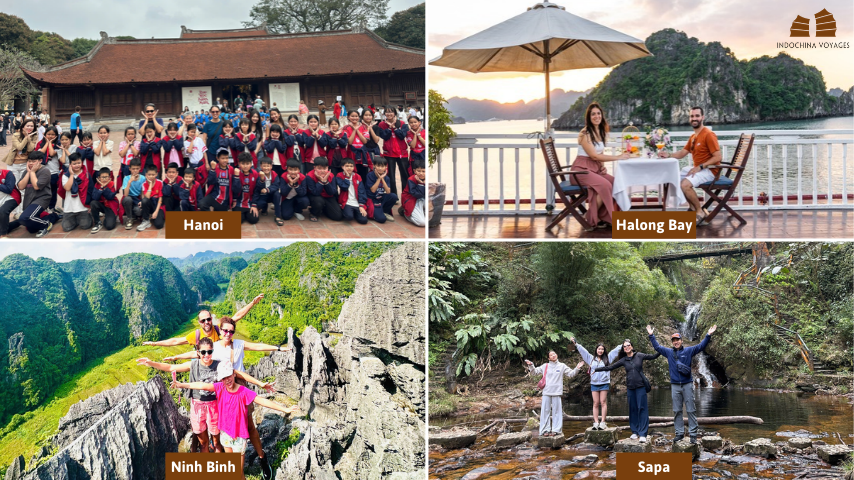
Ha Giang is the wilder option, best for adventurous travelers. Together with Dong Van, Meo Vac, Cao Bang, Ban Gioc Waterfall and Ba Be Lake, it forms one of Vietnam’s most dramatic journeys. It’s also the most road-intensive: expect long drives and winding mountain roads in exchange for remote scenery and ethnic minority culture.
Central Vietnam: Heritage, Food & Hoi An
Central Vietnam packs a lot into a compact area. Hue was the imperial capital, and its citadel and royal tombs reward a slow visit. Da Nang has beaches and easy airport access, and Hoi An’s lantern-lit Ancient Town is famous for tailoring, cooking classes and river life. My Son Sanctuary makes a good optional half-day, and cycling through the surrounding countryside adds a quieter side to the trip.

Southern Vietnam: Ho Chi Minh City & the Mekong Delta
The South is energetic and warm in every sense. Ho Chi Minh City mixes French colonial buildings, wartime history and a busy food scene. The Cu Chi Tunnels are an easy day trip, and the Mekong Delta shows everyday life on the water through floating markets, orchards and canal boat rides.
It’s possible to connect Hanoi, Central Vietnam and Ho Chi Minh City in a week using domestic flights. We wouldn’t call it the default route, but it suits travelers who value variety over a slower rhythm. More on this below.
5 Ways to Spend a Week in Vietnam
These routes cover different travel styles, from classic highlights to mountain adventures. Each can be adjusted to your dates and interests.
Hanoi, Ninh Binh & Halong Bay in 7 Days
A comfortable introduction for first-time visitors, with limited long-distance travel.
- Day 1: Arrive in Hanoi. Check in and take a gentle evening stroll around Hoan Kiem Lake.
- Day 2: Discover Hanoi. Visit the Temple of Literature, Ho Chi Minh Complex and Old Quarter, then finish with a street food tour.
- Day 3: Hanoi to Ninh Binh. Drive south (about 2 hours) and settle in among the rice fields.
- Day 4: Explore Ninh Binh. Take a sampan ride through Trang An or Tam Coc, then climb for views over the karst landscape.
- Day 5: Ninh Binh to Halong Bay. Transfer to the coast and board your overnight cruise.
- Day 6: Halong Bay cruise and return. Kayak, swim or join a cooking demo, then head back to Hanoi.
- Day 7: Hanoi and departure. Enjoy a last egg coffee before your flight.
Why it works: short transfers, a strong balance of culture and nature, and a pace that suits families and mature travelers.
Estimated cost: about $800–$950 per person (Superior to Deluxe hotels), or from about $1,150 in Luxury. The overnight Halong cruise is included in these estimates.
If this route appeals to you, you can see sample itineraries here, such as Tonkin Elegance 8 Days

Hanoi, Halong Bay & Sapa for Mountain Scenery
For travelers drawn to rice terraces, mountain villages and northern landscapes.
- Day 1: Arrive in Hanoi.
- Day 2: Explore Hanoi. Old Quarter, historic sites and a street food evening.
- Day 3: Hanoi to Halong Bay. Board your overnight cruise.
- Day 4: Cruise and continue toward Sapa. Return to Hanoi, then take the overnight train or a transfer to Sapa.
- Day 5: Sapa trekking and village experience. Walk through terraced valleys and meet local communities.
- Day 6: Further exploration around Sapa. Visit Fansipan Mountain or Silver Waterfall, then head back toward Hanoi.
- Day 7: Return to Hanoi and depart.
Note: This route involves noticeably more travel time than the Ninh Binh version, so it suits those who value mountain scenery over a relaxed pace.
Estimated cost: about $850–$1,000 per person (Superior to Deluxe), or from about $1,150 in Luxury, including the sleeper train or a private transfer to Sapa.
Curious about the terraces? Read more about the best rice fields in Vietnam, or ask us about custom Indochina packages built around your dates.

Ha Giang, Cao Bang & Ba Be: 7 Days on the Road
For those who want dramatic landscapes and a more adventurous side of Vietnam.
- Day 1: Hanoi to Ha Giang. Drive north and prepare for the journey ahead.
- Day 2: Ha Giang to Dong Van. Pass Quan Ba and the terraced valleys along the way.
- Day 3: Dong Van to Meo Vac and onward. Explore highland markets and minority villages.
- Day 4: Continue toward Cao Bang. Some of Vietnam’s most rugged terrain lies on this stretch.
- Day 5: Ban Gioc Waterfall and Nguom Ngao Cave.
- Day 6: Cao Bang to Ba Be. Settle in by Vietnam’s largest natural freshwater lake.
- Day 7: Ba Be Lake to Hanoi. Take a morning boat trip before the drive back.
Practical warning: Expect long driving days and winding mountain roads. Travel times can be much longer than the distances suggest, so this route is best for travelers who enjoy the journey itself.
Cost: $910 per person in Standard hotels or $972 in Superior for two travelers. Larger groups pay less, down to $485 per person for 7–8 travelers. Solo travelers add a single supplement of $139 (Standard) or $202 (Superior).
For a closer look, you might enjoy the Spirit of Northeast Vietnam Adventure, 7 Days.

Hue, Hoi An & Da Nang: A Week in Central Vietnam
Ideal for travelers interested in heritage, food and architecture at a leisurely pace.
- Day 1: Arrive in Da Nang and continue to Hoi An.
- Day 2: Hoi An Ancient Town. Go early, before the crowds arrive.
- Day 3: Hoi An countryside or cooking experience. Cycle through rice paddies or join a cooking class.
- Day 4: Hoi An to Hue. Take the scenic route over the Hai Van Pass.
- Day 5: Hue Imperial City and local highlights. Visit the Citadel, Thien Mu Pagoda and a royal tomb.
- Day 6: Hue to Da Nang. Relax on the beach or explore Da Nang’s sights.
- Day 7: Da Nang and departure.
My Son Sanctuary can be added as an optional half-day rather than a required stop.
Estimated cost: about $750–$850 per person (Superior to Deluxe), or about $1,150 in Luxury. For reference, our published Hidden Beauty Central Vietnam 6 Days (Quang Binh, Hue and Hoi An) costs $644 (Superior), $696 (Deluxe) or $978 (Luxury) for two travelers, and from $415 in a group of 7–8.
If Central Vietnam calls to you, our Indochina tours include several relaxed options worth a look.

Ho Chi Minh City & the Mekong Delta in One Week
A relaxed southern route combining urban energy with river life.
- Day 1: Arrive in Ho Chi Minh City. Stroll Nguyen Hue Walking Street in the evening.
- Day 2: Explore the city’s major sights. War Remnants Museum, Notre-Dame Cathedral Basilica and Ben Thanh Market.
- Day 3: Cu Chi Tunnels and free evening.
- Day 4: Ho Chi Minh City to the Mekong Delta. Take a boat through narrow canals and visit a coconut candy workshop.
- Day 5: Discover the Mekong. Visit a floating market early in the morning.
- Day 6: Return to Ho Chi Minh City. Enjoy a rooftop coffee or a spot of shopping.
- Day 7: Free time and departure.
Estimated cost: about $780–$950 per person (Superior to Deluxe), or about $1,275 in Luxury. Our published Southern Vietnam Discovery 6 Days is a close match at $667 (Superior), $810 (Deluxe) or $1,091 (Luxury) for two travelers, from $509 in a group of 7–8. An extra day in the delta is easy to add.
Thinking of time on the river? A Mekong cruise is a lovely way to slow things down, and Indochina Voyages can help you shape the rest of the route

What If You Want to See Vietnam from North to South?
We understand the appeal. Hanoi, Halong Bay, Hoi An and Ho Chi Minh City all sound too good to leave out. Fitting them into seven days is possible, but it comes with trade-offs.
What You Gain and What You Give Up
- You gain a taste of several regions, the major highlights, and a real sense of how different the landscapes and cultures are.
- You give up long stays, flexibility, and deeper local experiences, plus time in places like Ninh Binh, Sapa or the Mekong Delta.
If you have the time later, this is a great “first look” trip that can inspire a return visit to explore one region more deeply.
Please note that the above are all the suggested itineraries, and you can absolutely customize your tour based on your preferences. Indochina Voyages – one of the best Southeast Asia Tour Companies with more than 500+ Reviews (96% Excellent) on TripAdvisor. Our expert travel consultants are always available for you.
How Much Money is Enough for 1 Week in Vietnam?
VieCosts vary widely with travel style, so it helps to think in three broad categories. All figures are per person for 7 days, excluding international flights.
| Travel style | Approx. cost per day | 7-day total | What it usually covers |
|---|---|---|---|
| Budget (independent) | $45–$80 | $300–$550 | Guesthouses or hostels, local food, buses and trains, a budget cruise |
| Mid-range (private tour) | $107–$145 | $750–$1,000 | Superior to Deluxe hotels, private car and guide, entrance fees, a Halong or Mekong cruise |
| Private & comfortable | $160–$300 | $1,100–$2,100 | Luxury hotels and cruises, private guides and transfers, more inclusions |
A simple planning guide. When we help travelers set a daily budget, we usually talk in four steps: about $100 per person per day for essential comfort ($700 for 7 days), $150 for an enhanced experience ($1,050), $200 for a premium journey ($1,400) and $300 for an exceptional escape ($2,100).
Getting Around Vietnam During a One-Week Trip
Domestic flights save hours when connecting distant regions. One-way fares from Hanoi to Da Nang start around $24 on low-cost carriers, while Vietnam Airlines fares generally range from about $21 to $144 one way before taxes, depending on route, booking time and fare class. A direct Hanoi to Da Nang flight takes about 1 hour 25 minutes, and Hanoi to Ho Chi Minh City takes about 2 hours 10 minutes nonstop. Booking a few weeks ahead usually helps.
Private transfers are convenient for couples, families and travelers with limited time, since they run on your schedule. They’re included in our tour prices.
Trains are worth considering for selected northern routes and overnight journeys, such as Hanoi to Sapa.
Buses and shared transfers are a lower-cost alternative for certain connections.
| Route | Approx. journey time | Most practical option | Typical independent fare (one way)* |
|---|---|---|---|
| Hanoi – Ninh Binh | 2 hrs | Private car | $6–$12 (bus or train) |
| Hanoi – Halong Bay | 2.5–3 hrs | Private car / shuttle | $10–$15 (shuttle) |
| Hanoi – Sapa | 5–6 hrs by road; 8 hrs overnight train | Expressway transfer or sleeper train | $12–$20 (bus); $25–$50 (sleeper berth) |
| Hanoi – Ha Giang | 6–7 hrs | Private car | $12–$20 (sleeper bus) |
| Hanoi – Da Nang | 1 hr 25 min | Flight | $25–$90 |
| Da Nang – Hoi An | 45 min | Private car | $10–$15 (taxi or ride-hailing) |
| Hoi An – Hue | 3–4 hrs | Private car via Hai Van Pass | $10–$20 (shared bus) |
| Da Nang – Ho Chi Minh City | About 1 hr 25 min | Flight | $40–$90 |
| Ho Chi Minh City – Mekong Delta | 2–3 hrs | Private car | $8–$15 (bus) |
*Estimates for independent travelers. Private transfers are included in our tour prices.
When Is the Best Time to Follow a 7-Day Vietnam Itinerary?
Vietnam doesn’t have one uniform travel season, so the answer depends on where you’re going.
October to April is generally attractive for northern routes, with cooler, drier weather. Winters can be chilly and misty in Hanoi, Halong Bay and Sapa, while the South is at its driest.
May to August works well for Central Vietnam beaches and can suit selected northern journeys, though the North is hot and rainy, and the South sees regular afternoon showers.
September to November is a particularly rewarding period for northern landscapes, including golden rice terraces in early autumn. Central Vietnam needs closer weather planning at this time, as rain and typhoon risk rise.
For a month-by-month view, you can read more in our guide to the best time to travel to Vietnam.
Practical Things to Know Before Your Trip
Visa and entry requirements. Around 39 nationalities can enter visa-free, with stays ranging from 14 to 90 days, and 22 European countries receive 45 days. Citizens of the United States, Canada and Australia are not on the exemption list and need an e-visa for mainland Vietnam. The e-visa is open to all nationalities at evisa.gov.vn and costs USD 25, and it is valid for 90 days with multiple entries. Your passport must be valid for at least six months beyond your date of entry. Rules change from time to time, so please confirm on the official government portal before you book. Vietnam Visa Exemption 2026: Complete Countries List +4
Money and payments. Cash is still widely used, especially in smaller towns and markets. Cards are accepted in most hotels and larger restaurants, and ATMs are easy to find in cities.
SIM cards and internet. SIM and eSIM options are inexpensive and available at airports and convenience stores. Wi-Fi is common in hotels, cafes and restaurants. If you’d like to compare providers, here’s a helpful guide to the best mobile network in Vietnam.
Electricity. Vietnam uses 220V with Type A and Type C plugs, so a universal adapter is a good idea. Our electricity in Vietnam guide covers plugs, voltage and power cuts in more detail.
What to pack. Adapt to your route and month: layers and a light jacket for the North in winter, rain protection for the wet season, and comfortable walking shoes for treks and old towns. Our Vietnam packing list can help.
How much time to leave between connections. On a one-week itinerary, a delayed flight can affect the whole trip. Keep buffers around domestic flights, and avoid scheduling tight connections on your last day.
For more first-time tips, see our guide to planning a trip to Vietnam, or let Indochina Voyages take care of the details.
FAQ
Still have questions? Visit this page to browse our Vietnam tours, or write to us at info@indochinavoyages.com. Our team would be happy to help.
Related Reading
- Vietnam itinerary in 5 days
- Vietnam travel itinerary: 10 days
- 12 days in Vietnam
- How to plan the best Vietnam itinerary in 2 weeks
- Guide for planning a Vietnam itinerary in 3 weeks
- Planning a trip to Vietnam
- Best time to travel to Vietnam
- Best mobile network in Vietnam
- Best rice fields in Vietnam
Get Your Free Personalized Itinerary
Tell us about your trip and one of our Vietnam travel specialists will reply within 24 hours, no obligation, no hidden fees.
Trang Nguyen – IV Travel Specialist